Every Gram Accounted For:How Dew Diamonds Brought Real-Time Visibility to the Production Floor
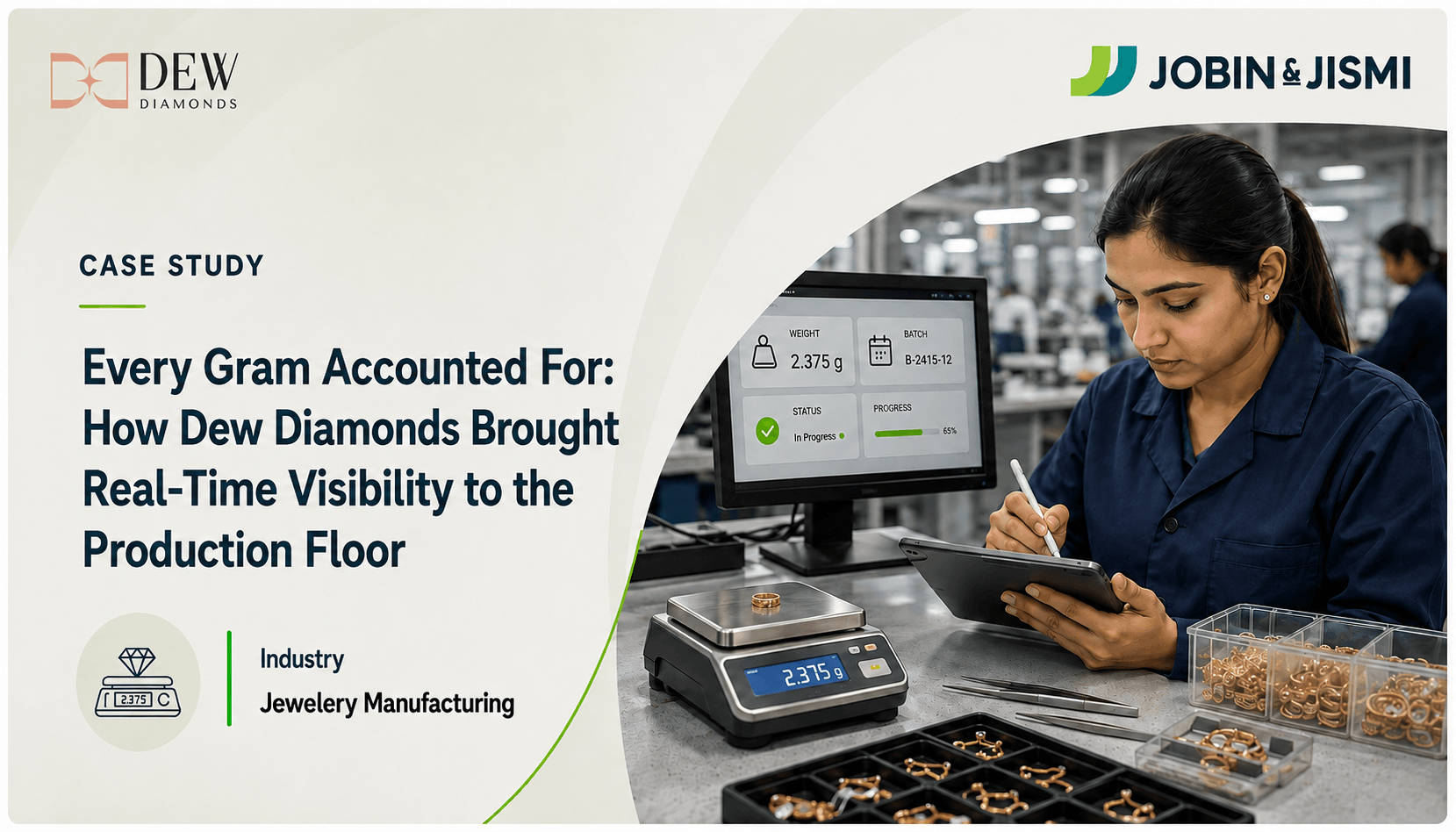
Every Gram Accounted For:How Dew Diamonds Brought Real-Time Visibility to the Production Floor
Dew Diamonds India
Jewellery Manufacturing
April 2026
NetSuite Customization

Overview
In a fine jewelry manufacturing operation, raw materials — gold in multiple purity grades, loose diamonds, and color gemstones — move through a complex series of production stages before a finished piece leaves the facility. At Dew Diamonds, this movement was happening without any real-time digital trail. Bags of material were passed between departments on trust and paper records, leaving management with no reliable way to answer the most basic questions: Where is this material right now? Has it been processed? Who last handled it?
For a business where the contents of a single bag can represent significant financial value, this lack of visibility carried real operational and financial risk. Jobin & Jismi designed and built a production floor tracking system — integrated directly into Dew Diamonds' existing NetSuite manufacturing environment — that gives every bag of material a live digital identity from the moment it's prepared through to finished goods.
The result: complete traceability of every gram of gold, every parcel of diamonds, and every batch of gemstones moving through the production floor, with instant label printing, real-time status visibility, and a full audit trail that managers can consult at any time.
At a Glance
digitally tracked from preparation through finished goods — no unrecorded movement
gold (multiple purity grades), diamonds, color stones, and alloys — unified under one tracking system
bag labels generated on demand — no manual writing, no illegible handwriting on high-value parcels
managers see exactly which department holds each bag and its processing status — in real time
works across customer orders, stock manufacturing, repair jobs, and outsourced job work
The Business Challenges
Running a jewelry manufacturing floor means managing some of the most expensive materials in any industry. Before this project, the movement of those materials operated largely on informal processes — effective when the business was smaller, but increasingly fragile as production scaled.
When a manager needed to know the status of a specific batch — a parcel of diamonds sent for setting, or gold sent to the casting department — the only way to find out was to physically walk the floor and ask. There was no central view of what was in transit, what had been processed, or what was waiting. In a busy manufacturing facility handling multiple orders simultaneously, this created constant interruptions and delays.
As bags moved from one production stage to the next — from raw material receipt through to barcoding and finished goods — handoffs were recorded, if at all, on paper slips or in spreadsheets updated after the fact. Records were often incomplete, and when a discrepancy arose, tracing back through the chain was a time-consuming manual exercise with no guarantee of accuracy.
Physical bags needed to be identified with their contents, weights, and relevant job details. Labels were handwritten by production staff — meaning they varied in format, could be illegible, and occasionally contained errors in critical details like metal purity or carat weight. For a business where a difference of 0.1 grams or one purity grade carries real financial and customer implications, inconsistent labelling was a genuine risk.
Gold is measured in grams and tracked by purity grade (G14, G18, G22, G994). Diamonds are tracked by carat weight, millimetre size, and quality grade. Color stones have their own classification. In the absence of a purpose-built system, each material type was managed differently — making it impossible to get a single, consolidated view of what was on the floor at any given moment.
Dew Diamonds operates across multiple order types: standard customer orders, stock manufacturing runs, repair jobs returning from clients, and outsourced job work. Each has different priorities and routing requirements. Without a system that recognised these distinctions, production staff had to manually track which bags belonged to which type of order — adding unnecessary cognitive load and increasing the risk of mix-ups.
The Solution
Jobin & Jismi built a bag-level production tracking system embedded directly into Dew Diamonds' NetSuite environment. Every physical bag of material on the production floor now has a live digital record — visible in real time to anyone in the business with the right access.
The moment a bag is prepared for production, it is registered in the system with its material type, weight, purity grade or quality classification, department destination, and associated order. This record travels with the bag through every stage of manufacturing — creating a continuous digital thread from raw material to finished goods. Nothing moves without leaving a trace.
Every bag in the system has a visible status — whether it is in transit between departments, ready to be processed, or completed at a given stage. Managers can view all active bags across the facility at once, filtered by department, material type, or order, without needing to physically walk the floor or interrupt production staff to find out what's happening.
Labels for physical bags are generated by the system and printed on demand. Each label is drawn directly from the bag's digital record — meaning every label is consistent in format, accurate in its details, and legible. For diamonds, labels include carat weight and quality grade. For gold, labels display the correct purity classification. No handwriting, no interpretation required.
The system understands the differences between material types and handles each accordingly. Gold is tracked by purity grade. Diamonds are tracked by carat weight, physical size, and quality grouping. Color stones are classified separately. All of this flows into a single production view, so a manager overseeing the floor sees one consistent picture regardless of which material type they are looking at.
The tracking system recognises whether a bag belongs to a customer order, a stock manufacturing run, a repair, or an outsourced job work order. This distinction flows through every record — so production staff and managers always know what kind of job a bag is associated with, its priority level, and any special handling requirements specific to that order type.
Every movement, status change, and processing event for every bag is recorded automatically. When a question arises — about when a batch was processed, which department handled it, or what the recorded weight was at a specific stage — the answer is available immediately from a single lookup. There is no need to piece together handwritten records or rely on staff recollection.
How It Was Delivered
The project was structured to get core tracking live quickly, then build out the full capability across material types and order flows.
Business Impact
The shift from paper-based, informal bag tracking to a live digital system changed how production is managed across the facility.
In jewelry manufacturing, the financial exposure from untracked material movement grows with the business. A bag tracking system is not just an operational improvement — it is a risk management foundation. As Dew Diamonds' production volume increases, the system scales with it: every new bag, every new department, every new order type is handled by the same infrastructure. The investment made at implementation continues to pay out as the business grows.
What this Project Taught Us
Lessons from this implementation that are relevant to any jewelry or precision manufacturing business considering a similar step.
- Visibility is a prerequisite for accountability. You cannot hold a production floor accountable for material movements you cannot see. The foundation of any inventory loss prevention strategy is knowing where things are in real time — and that requires a system, not a policy.
- Generic inventory tools fall short for precious materials. Standard stock management handles quantity and location. Precious material manufacturing also needs purity grade, quality classification, carat weight, and lot integrity. Tracking built for your industry carries information that generic tools cannot.
- Adoption on the production floor requires simplicity above all else. The best tracking system in the world has no value if staff bypass it. Designing for the minimum number of steps — in the language of the people who will use it — is not a nice-to-have; it is what determines whether the system actually works.
- Building inside your existing ERP avoids the trap of parallel systems. When tracking lives inside the same system as purchasing, manufacturing orders, and inventory, the data stays consistent and staff work in one place. Standalone tracking apps always require someone to maintain the link — and that link always breaks under pressure.
Frequently Asked Questions
Questions we commonly hear from jewelry and precision manufacturing businesses evaluating production floor tracking.
The need for material tracking doesn't depend on size — it depends on the value of what you're moving. If the contents of a misplaced or mislabelled bag represent meaningful financial exposure, a tracking system pays for itself quickly. Smaller operations often benefit more from the simplicity that a well-designed system brings: fewer manual checks, less time spent answering "where is X" questions, and clearer accountability across a smaller team.
This is built as a native extension of NetSuite, not a separate system sitting alongside it. Bag records link directly to your existing items, purchase records, and manufacturing orders. Your existing inventory, purchasing, and order management workflows continue unchanged. The tracking layer adds granularity — piece-level and bag-level visibility — without replacing or duplicating what's already there.
Yes. The material tracking model is designed to be extended. The core system handles gold (across multiple purity grades), diamonds, and color stones as distinct material types — each with the relevant tracking fields for that material. Adding platinum or additional stone categories is a configuration exercise, not a rebuild. The fields that appear for each bag type are determined by the material classification, so production staff only ever see what's relevant to the bag they're working with.
In our experience, production floor adoption typically happens within the first few weeks once the system is live — provided the interface is designed for simplicity. The most important factor is making sure the system matches how work actually flows on your floor: the right departments in the right order, the right status options for your process, and the minimum number of steps for common actions. We spend time before and during implementation understanding your specific flow so the system reflects it rather than forcing staff to adapt to generic defaults.
Labels are generated as standard PDFs and print to any printer accessible from your network. For dedicated label printers, the label format and dimensions can be configured to match your hardware. The label content is pulled live from the bag record at the moment of printing, so every label reflects the current state of the record — no risk of printing outdated information.
Yes. The system tracks order type as part of every bag record — distinguishing between customer orders, stock manufacturing runs, repair jobs, and outsourced job work. This distinction is visible to staff on the production floor and to managers in the overview. It means materials for different job types are clearly separated in the system even when they're physically close on the floor.
We typically begin with a discovery phase where we map your current production flow — the departments, the material types, the order types, the handoff points. This gives us the foundation to configure the tracking model correctly before any build begins. From there, implementation is phased: core tracking first, then material-specific handling, then label printing, then any advanced views or filters. We aim to have the core system live and in use early so feedback from actual production staff can shape the later phases.
If the movement of gold, diamonds, or precious materials through your facility isn't fully traceable in real time, you have a risk that grows with your business. Let's talk about what a bag tracking system could look like for your operation.
About Jobin & Jismi IT Services LLP
Jobin & Jismi is an Oracle NetSuite partner specialising in fine jewelry manufacturing, diamond trading, and high-value goods industries. Founded by practitioners with deep expertise in both ERP and the operational realities of jewelry production, the firm brings an unusually industry-specific perspective to every NetSuite engagement.
The firm's work spans the full manufacturing lifecycle — from custom production floor tools and procurement workflows through to customer-facing portals, compliance automation, and financial process design. Clients include some of India's leading diamond jewelry manufacturers.
Learn more about Dew Diamonds' business at dewdiamonds.com, or explore the Oracle NetSuite Manufacturing suite that underpins this work.
Related Case Studies


Automate Financial Workflows with NetSuite-ICICI Bank Integration


Dynamic Graphical Reports for Customer Sales in NetSuite