
Re-Engage Customers
Automates the identification of dormant customers and sends personalized re-engagement emails, followed by configurable sales rep follow-up notifications, improving customer retention and sales efficiency.
- SKU :PDNSREC01
- Last Update :June 2025
- Support for :NetSuite
- Implementation time :2 Business Days
Re-Engage Customers
Dormant Customer Re-engagement and Sales Follow-Up Automation
Re-engage inactive customers in NetSuite with an automated solution that identifies dormant accounts and sends personalized emails after certain period of inactivity. It schedules follow-up reminders for sales reps, excludes new customers, and uses smart tracking to avoid repeat outreach—enhancing retention and supporting sales initiatives.
Automated Re-engagement of Dormant Customers with Personalized Outreach and Sales Rep Follow-Up
Automatically identifies customers with no transactions or activities for a certain period, ensuring that only truly inactive accounts are targeted for re-engagement. This improves campaign precision and reduces unnecessary outreach.
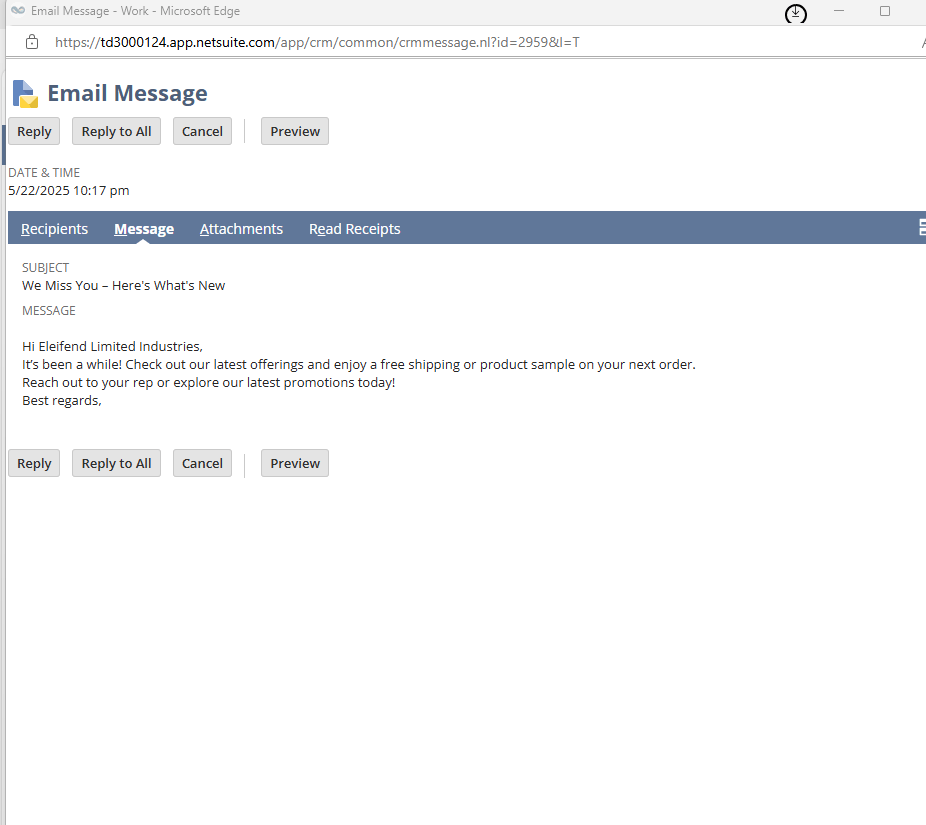
Sends personalized re-engagement emails to dormant customers, highlighting new products, promotions, or offers. The messaging is designed to re-capture interest and encourage repeat business without manual effort.
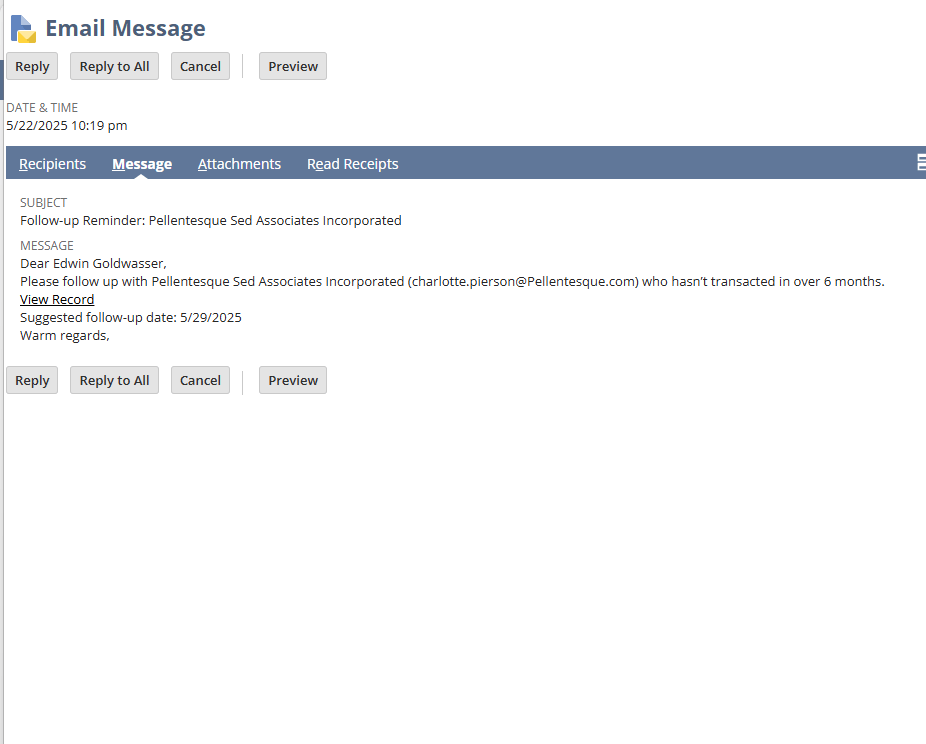
Automatically notifies the assigned sales representative after a configurable number of days, prompting timely follow-up with the dormant customer. This ensures a human touch and increases the likelihood of reactivation.
Excludes newly created customers from email campaigns and prevents duplicate outreach and ensuring communication relevance.
Re-Engage Customers consolidates customer data from across NetSuite into a single, consistent profile. Sales history, support interactions, invoices, subscriptions, engagement history, and service records are accessible from one interface, enabling teams to understand customer context before initiating any re-engagement activity.
Support interactions, service cases, and issue histories are directly linked to customer records. This ensures that re-engagement efforts are aligned with service quality, unresolved issues, and customer satisfaction signals, helping teams avoid generic outreach and focus on relationship recovery.
The Customer 360 Dashboard provides a consolidated operational and engagement view, bringing together transaction data, communication history, service interactions, lifecycle stage, and engagement status. This allows business teams to track inactivity trends, identify drop-off points, and prioritize re-engagement actions based on real data.
AI-driven analytics help identify behavioral patterns, churn risk indicators, and engagement opportunities using historical customer data. These insights enable predictive segmentation and intelligent targeting, helping teams focus re-engagement efforts on customers with the highest probability of conversion.
Re-engagement workflows support targeted and personalized communication based on customer behavior, lifecycle stage, transaction history, and preferences. Campaigns can be aligned to specific customer segments, ensuring relevance rather than generic mass outreach.
Customers can independently access account details, order history, invoices, subscriptions, and service requests through a secure self-service portal. This improves customer experience while reducing dependency on support teams and strengthening long-term engagement.
Integrated case management ensures every customer issue, interaction, and resolution is tracked within NetSuite. Re-engagement strategies can be aligned with open or resolved cases, ensuring communication is timely, relevant, and service-driven.
Automated renewal notifications and reminders help prevent unintentional churn. Customers receive timely alerts for contract renewals, subscriptions, and service expiries, supporting retention and continuity of engagement without manual follow-ups.
Implementation Prerequisites and Usage Conditions
- Assign customer and email campaign permissions to sales and marketing roles involved.
- Customer records have valid email addresses and are marked as active.
- Set up and configure the email template to be used for re-engagement messages.
Boosting Customer Retention through Intelligent Inactivity Detection and Targeted Email Campaigns
- Re-engages inactive customers through automated emails
- Promotes brand recall and encourages repeat purchases
- Notifies sales reps automatically for follow-up
- Allows teams to focus on high-potential accounts
- Filters out new and recently active customers
- Ensures only relevant contacts receive emails
- Uses a tracking field to monitor sent emails
- Prevents duplicate or excessive outreach
By using centralized data, AI insights, and behavioral segmentation, businesses can deliver relevant, context-aware communication. This enables meaningful engagement instead of generic campaigns, improving response rates and relationship quality.
Consistent engagement, proactive service, and personalized communication strengthen customer trust and satisfaction. Over time, this drives higher retention, repeat business, and long-term loyalty across the customer lifecycle.
Frequently Asked Questions
A customer is considered dormant if they have had no transactions within a certain period of time from the current date. The system also excludes customers who were created within this timeframe window.
No, the system automatically excludes customers who were created within the certain period to avoid contacting new customers prematurely with re-engagement emails.
The system validates a field on the customer record to track whether a re-engagement email has already been sent. No additional emails are sent unless the customer becomes active again.
Sales representatives are automatically notified via email a configurable number of days after the initial re-engagement email is sent to the customer. The notification includes customer details and a direct link to the customer record, prompting timely and personalized follow-up.
Yes, the follow-up delay is fully configurable. Administrators can set the number of days after which the sales rep should be notified, allowing flexibility based on business preferences.
Inactive or dormant customers can be identified using saved searches, reports, and dashboard KPIs based on transaction history, last activity date, communication logs, or engagement metrics. These views can be customized to reflect business-specific inactivity criteria.
Customer lists can be created using NetSuite saved searches and segmentation rules. Filters such as inactivity period, purchase frequency, contract status, support history, and lifecycle stage help build structured re-engagement target lists.
Target groups are created through customer segmentation using predefined conditions and dynamic filters. These groups automatically update as customer data changes, ensuring re-engagement campaigns remain accurate and relevant.
Effective engagement combines data-driven targeting, personalized communication, proactive support, service transparency, and consistent follow-ups. Structured workflows, automation, and lifecycle-based engagement strategies are key to long-term retention.
NetSuite CRM centralizes customer data, tracks engagement history, automates workflows, supports segmentation, and integrates sales, service, and marketing activities. This creates a connected platform for identifying inactive customers and executing structured re-engagement strategies.