

European E-Invoicing Mandate 2026: NetSuite Guide

July 08,2026


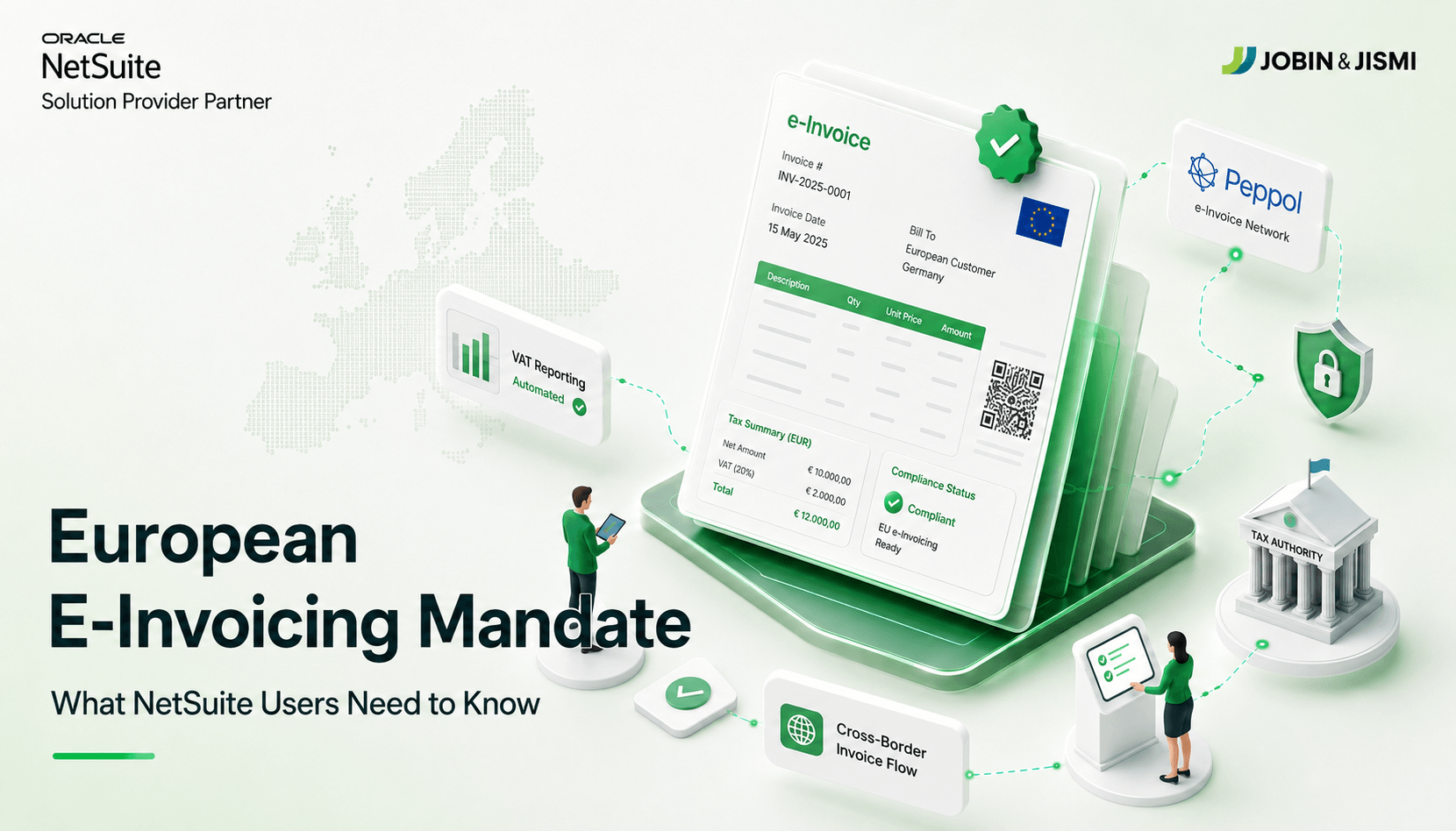
European countries are entering a new era of tax compliance. VAT in the digital age initiative is reshaping how businesses manage invoicing and reporting. Business leaders can no longer treat compliance as a future initiative. With multiple countries introducing e-invoicing mandates in 2026, Oracle NetSuite users must prepare for real-time reporting requirements, standardized data formats, and evolving compliance frameworks that will fundamentally change ERP processes, integrations, and financial processes.
What is ViDA?
ViDA is one of the most significant EU VAT reforms in decades to modernize VAT reporting through the digital VAT gap, which has exceeded 90 billion euros in recent years. This represents lost tax revenue due to fraudulent processes. It aims at vision-driven objectives such as reducing compliance costs, increasing tax regulation, and reducing tax fraud. The primary driver behind this transformation is the porting errors and inefficiencies in the traditional systems. ViDA encourages standardized e-invoicing, digital reporting requirements, and cross-border simplification measures.
What is E-invoicing?
E-invoicing is the digital exchange of invoices between supplier and buyer systems in a structured, machine-readable format. Unlike emailed PDF invoices, true e-invoicing uses structured data formats that ERP systems can process automatically without manual intervention. The usage of structured formats like XML or JSON and enables systems to automatically validate, process, and record transactions. They are typically transmitted through secure networks like Peppol or government-approved platforms, ensuring data accuracy, traceability, and compliance across the entire invoice cycle.
Why are governments mandating E-invoicing?
Strengthened Fraud Prevention: Through e-invoicing, tax authorities gain instantaneous visibility into the transaction, allowing them to prevent discrepancies and tax fraud.
Operational Efficiency: By enabling straight-through invoice processing, it eliminates manual data entry, reduces errors, and accelerates approval workflows.
Enhanced Data Accuracy: Structured invoice data ensures clean, standardized, and validated financial information, which improves the reconciliation processes, supports three-way matching, and enables advanced analytics.
Optimized Cash Flow: E-invoicing accelerates billing and payment cycles, positively impacting both DSO and DPO.
What are the different types of E-invoicing methods?
Post Audit: In this model, invoices are exchanged directly between businesses without real-time intervention from the tax authority. Verifications take place when businesses submit their periodic VAT returns or when a tax audit is conducted. At that stage, authorities review transaction data, reconcile reported figures with submitted documentation, and identify potential fraud.
- Direct exchange model (Germany): In this setup, the structured invoices are sent directly from the supplier to the buyer with no central platform in between. The tax authority reviews the invoices retrospectively rather than at the point of issuance.
- Continuous Transaction Control (CTC) Approach: In this model, real-time visibility is ensured by the involvement of the tax authority at or close to the point of invoice creation. Across Europe, there is a growing shift toward CTC frameworks, with initiatives such as ViDA accelerating their adoption
- Clearance Model (Italy, Poland, Romania): In the clearance model, each invoice is submitted to a government platform for validation and approval before it is considered legally valid and delivered to the customer. This allows for validating the data in real time and ensures that VAT is correctly recorded before the final submissions.
- Decentralized exchange model (France): Rather than a single central government system, the invoices are exchanged between trading partners through approved private platforms. Accredited by the tax authority, these platforms facilitate the secure transmission of structured invoice data while simultaneously reporting relevant information to the tax authority.
- Peppol-based exchange model (Belgium & Nordic countries): In this model, businesses are connected to the Peppol network through a certified access point, enabling them to exchange standardized electronic invoices with trading partners across the network. Invoices are transmitted directly between participants without passing through a central government platform. Real-time reporting requirements are introduced separately depending on the regulatory framework.
- Real-time reporting model (Hungary, Greece): In this approach, businesses continue to issue invoices directly to their customers using their existing processes. However, the relevant invoice data is simultaneously reported to the tax authority in a structured digital format. This allows real-time visibility into transactions without intervening in the actual invoice exchange.
European E-Invoicing Standards & Formats
Each country enforces different technical standards and formats. Understanding them is important for interoperability across ERP systems and government platforms.
Standard | Definition | Why it Matters |
EN 16931 | The European semantic standard defining the core data elements of an invoice. It is the base for almost every European format. Used across the EU as the common reference. | Ensures every invoice carries the same information in the same meaning, enabling interoperability. Becomes mandatory for intra-EU B2B invoicing from 2030 under ViDA. |
UBL 2.1 | One of the two official syntaxes that expresses EN 16931 in XML. Used by Peppol, Italy, Spain, Belgium and the Nordics. | The most widely adopted invoice syntax in Europe; the default for Peppol-based exchange. |
UN/CEFACT CII | The second official EN 16931 syntax. Used by France and Germany. | Underpins hybrid formats such as Factur-X and ZUGFeRD. |
Peppol BIS Billing 3.0 | An EN 16931 specification (CIUS) delivered over the Peppol network using UBL. Used by Belgium, Sweden, Finland. | Enables secure, standardized invoice exchange across 40+ countries without a central government platform. |
Factur-X / ZUGFeRD | A hybrid invoice combining a human-readable PDF with embedded CII XML (the two names are technically identical). Used in France (Factur-X) and Germany (ZUGFeRD). | Both human- and machine-readable, easing the transition for businesses still reliant on PDFs. |
XRechnung | The German national adaptation (CIUS) of EN 16931, available in UBL or CII. Used in Germany for public-sector invoicing (B2G). | Mandatory for invoicing German government bodies. |
National formats (CIUS / XML schemas) | Country-specific formats built on EN 16931, including FatturaPA (Italy), FA(3) (Poland), Facturae (Spain), RO e-Factura (Romania), CIUS-PT (Portugal) and OIOUBL (Denmark). | Each format is mandatory in its own country, but all align to EN 16931 - so the underlying data stays consistent. |
European E-Invoicing Mandate Timeline
Organizations operating across multiple jurisdictions must prepare for varying compliance models and implementation schedules. The evolving country wise mandates and deadlines are the following:
Country | Mandate type | Status | Key dates / phases | Scope | Standard / Platform |
Belgium | E- invoicing | Live | Mandatory 1 Jan 2026; tolerance ended 31 Mar 2026, penalties from 1 Apr 2026; Peppol 5-corner e-reporting planned 2028 | Domestic B2B | Peppol BIS Billing 3.0 |
Croatia | E-invoicing + fiscalization | Live (phased) | VAT-registered issue & receive 1 Jan 2026; non-VAT-registered receive 2026, issue 1 Jan 2027; B2C fiscalization from 2026 | B2B, B2G & B2C fiscalization | National system / Peppol (EN 16931) |
Denmark | Digital bookkeeping (not e-invoicing) | Live (phased) | Certified systems Jul 2024; self-developed Jan 2025; turnover >DKK 300k Jan 2026; small in-house Jul 2026 | Digital bookkeeping | OIOUBL / Peppol (NemHandel) |
Finland | E-invoicing + right to demand | Live (B2G) | B2G mandatory since 1 Apr 2019; buyers (turnover >€10k) can demand an e-invoice since Apr 2020; no B2B mandate | Public sector | Peppol BIS / Finvoice / TEAPPS |
France | E-invoicing + e-reporting | Upcoming | Receive (all) + issue & e-reporting (large & mid) 1 Sep 2026; issue & e-reporting (SMEs & micro) 1 Sep 2027 (decree may defer to Dec) | All businesses | Approved Platforms (PA, ex-PDP); Factur-X, UBL, CII |
Germany | E-invoicing | Phased | Receive since 1 Jan 2025; issue (turnover >€800k) 1 Jan 2027; issue (all) 1 Jan 2028 | Domestic B2B | XRechnung, ZUGFeRD/Factur-X |
Greece | E-invoicing (via myDATA) | Phased (Phase 1 live) | Phase 1 (revenue >€1M, FY2023) 2 Mar 2026 (tolerance till 3 May 2026); Phase 2 (all others) 1 Oct 2026 | Domestic B2B (+ to non-EU) | myDATA |
Hungary | E-reporting (not e-invoicing) | Live | RTIR since 1 Jul 2018; all domestic B2B Jul 2020; B2C/intra-EU/export 1 Jan 2021 (mandatory XSD v3.0 from 1 Apr 2021) | All B2B & B2C | NAV Online Invoice (RTIR) |
Italy | E-invoicing | Live | Domestic B2B & B2C since 1 Jan 2019; cross-border via SdI since 1 Jul 2022; all businesses since 1 Jan 2024 (exemption removed) | B2B & B2C | SdI / FatturaPA (XML) |
Latvia | E-invoicing | Upcoming | B2G/state reporting to VID 1 Jan 2026; voluntary B2B 30 Mar 2026; mandatory B2B (+ data to VID) 1 Jan 2028 | B2G + B2B | Peppol BIS Billing 3.0 |
Poland | E-invoicing,
| Live (phased) | Large (>PLN 200M) 1 Feb 2026; all others 1 Apr 2026; micro-entrepreneurs 1 Jan 2027 | Domestic B2B | KSeF / FA(3) |
Portugal | B2G + fiscalization | Live (B2G) | B2G large since 2021, SMEs since 1 Jan 2026; ATCUD + QR on all invoices; QES required for PDF invoices from 1 Jan 2027(subject to change); B2B otherwise voluntary | Public sector (+ fiscalization) | CIUS-PT |
Romania | E-invoicing (B2B) + e-reporting (B2C) | Live | B2B since 1 Jan 2024; B2C reporting since 1 Jan 2025 | Domestic B2B & B2C | RO e-Factura / RO_CIUS |
Serbia (non-EU) | E-invoicing | Live | B2G receiving from 1 May 2022; B2B since 1 Jan 2023; further SEF reforms in 2026 | B2G & B2B | SEF (UBL 2.1) |
Slovakia | E-invoicing + e-reporting | Upcoming,
| Voluntary live e-invoicing from May 2026; mandatory B2B & B2G 1 Jan 2027; intra-EU 1 Jul 2030; transmission is restricted to certified providers ("Digital Postmen") over Peppol 1 Jul 2027 | Domestic & intra-EU B2B (+ B2G) | Peppol 5-corner; EN 16931, UBL/CII |
Slovenia | E-invoicing | Upcoming | Mandatory B2B 1 Jan 2028 (law adopted Oct 2025); no tax-authority reporting | Domestic B2B | e-SLOG / EN 16931 (via providers, Peppol, or government app) |
Spain | E-invoicing (Crea y Crece) + reporting (VeriFactu) | Upcoming | VeriFactu: CIT payers 1 Jan 2027, others 1 Jul 2027. | Domestic B2B + software reporting | Facturae (+ UBL/CII/EDIFACT); VeriFactu |
Sweden | E-invoicing | Live (B2G) | B2G via Peppol since 1 Apr 2019; B2B mandate under government inquiry (findings due Nov 2027) | Public sector | Peppol BIS
|
Common Challenges Businesses Face in European E-Invoicing Mandates
Multiple country mandates: Businesses must navigate different national e-invoicing rules across Europe, each with unique compliance timelines, reporting requirements, and enforcement models
Multiple invoice standards: European countries adopt different structured invoice formats - UBL, CII syntaxes and the EN 16931-based formats (Factur-X, XRechnung, and national schemas) built on them requiring businesses to support multiple formats across jurisdictions.
ERP integration complexity: Integrating ERP systems with government clearance platforms,Peppol access points, and third-party compliance providers often requires configuration, customization, and ongoing maintenance
Changing legislation: Continuous regulatory updates across EU member states demand ongoing monitoring and rapid adaptation to remain compliant and avoid penalties
Platform and network onboarding: Connecting to e-invoicing ecosystems involves setup across both private networks and government platforms, including integration with Peppol access points and compliance with country specific systems such as Sdl,KSeF,myDATA and Plateforme Agréée.
Tax validation: In clearance and real-time reporting models, businesses must necessitate precise tax calculations and accurate data alignment with local VAT rules to meet tax authority validation requirements.
Invoice rejection handling: Automated compliance checks increase rejection rates, requiring efficient workflows to quickly resolve errors and maintain cash flow continuity.
Cross-border transactions: Managing invoices across jurisdictions introduces additional complexity due to varying tax treatments, reporting obligations, and interoperability requirements
How does Avalara Integration Overcome European E-Invoicing Challenges in Clearance and Real Time Reporting Models?
Businesses require more than an ERP system to stay compliant with evolving e-invoicing mandates. While NetSuite manages the core operational processes, businesses require a compliance solution that can adapt to country-specific regulations, compliant invoice formats, and connect with government platforms and tax exchange networks. By automating invoice validation, format conversion, and submission workflows, Avalara simplifies the compliance processes. While NetSuite handles core operations, NetSuite Electronic Invoicing powered by Avalara embeds Avalara E-Invoicing and Live Reporting to manage validation, format conversion and submissions across countries distinct from AvaTax which focuses only on tax calculation.
Supports Live E-Reporting Obligations: Avalara automates the submissions of invoice and transaction data to government platforms, helping businesses to meet reporting deadlines, reduce compliance risk and maintain consistency across multiple countries through a single solution.
Supports Multi-Country Mandates: By supporting different government platforms, reporting models, and integration timelines, Avalara helps businesses comply with country-specific e-invoicing regulations. Businesses can scale their operations according to the introduction of new mandates.
Generates Country-Specific Invoice Formats: As European countries require invoices in different structured formats such as UBL, Factur-X, CII, XRechnung, and country-specific XML schemas, Avalara automatically transforms the invoice data generated in NetSuite to the appropriate format required for each jurisdiction.
Simplifies Peppol Connectivity: Connecting to the Peppol network usually involves complex technical processes. Avalara streamlines this process by acting as a certified access point, providing secure connectivity while handling data transformations into Peppol-compliant formats, validation requirements, and messaging protocols.
Reduces the Risk of Invoice Rejections: Avalara applies country-specific validation rules, standardizes formats, and verifies tax calculations in line with local VAT requirements, minimizing errors that typically trigger rejections. By minimizing invoice errors, businesses can reduce rejection rates, prevent payment delays, and maintain uninterrupted order-to-cash and procure-to-pay processes.
Supports Cross-Border Compliance: Managing cross-border transactions in Europe requires organizations to align with varying tax rules, reporting obligations, and interoperability standards across multiple jurisdictions. Avalara simplifies this complexity by enabling businesses to manage diverse e-invoicing and reporting requirements through a single compliance solution.
How Avalara NetSuite Integration Works
Invoice Origination in NetSuite: Invoices continue to be generated within NetSuite as the system of record. However, greater emphasis is placed on data integrity, structured fields, and VAT accuracy, as these form the foundation for downstream compliance.
Seamless Data Exchange: Invoice data is transmitted automatically to Avalara’s e-invoicing engine in real or near real time, ensuring that compliance checks are applied proactively.
Format Transformation and Standardization: Avalara converts invoice data into jurisdiction-specific structured formats, addressing the fragmentation of standards across European countries
Regulatory Validation and VAT Compliance: The platform enforces country-specific validation rules, including mandatory data elements, VAT treatments, and legal requirements. This significantly reduces the risk of non-compliance and invoice rejection.
Network Connectivity and Submission: Avalara reduces the need for organizations to build and maintain multiple integrations through the secure connection to Peppol and local tax authority platforms
Status Visibility and Exception Handling: NetSuite Avalara Integration provides a transparent and controlled invoicing process by embedding status tracking and exception management directly into the financial workflow.
Continuous Regulatory Alignment: With the evolution of the European mandates, Avalara continuously updates its compliance engine to reflect changing legislation, formats, and reporting requirements, reducing the burden on internal IT and finance teams.
Conclusion
European e-invoicing mandates are no longer a future consideration; instead, it is an immediate compliance requirement for organizations operating across Europe. Delays in addressing these mandates result in costly consequences such as invoice rejections, disrupted cash flow, and increased regulatory risk. NetSuite Avalara Integration enables organizations to confidently meet evolving mandates by embedding compliance, automation, and real-time visibility into the core financial workflow.
Stay ahead of the shifting e-invoicing mandates with Jobin and Jismi.
Partner with Jobin and Jismi, the trusted NetSuite implementation and Avalara partner to transform e-invoicing from a compliance burden into a strategic advantage, enhancing accuracy, accelerating cash flow and ensuring scalable growth across Europe. Connect with our experts today.
on LinkedIn



Frequently Asked Questions
ViDA is an EU initiative aimed at harmonizing digital reporting and e-invoicing across member states. It introduces real-time reporting requirements and standardized frameworks requiring businesses to adopt more automated and compliant invoicing processes.
European countries use multiple structured formats based on the EN 16931 standard, primarily built on the UBL and CII syntaxes. These include implementations such as Factur X, XRechnung and various country specific XML schemas. These structured formats are designed to support automated validation and seamless integration with tax authority systems but require businesses to manage multiple standards.
European e-invoicing mandates require invoices to be issued in structured digital formats and, in many cases, reported to tax authorities in real or near real time. They are important because they improve tax transparency, reduce fraud, and ensure tighter regulatory control over financial transactions.
The integration standardizes invoice processing and embeds compliance into the workflow, enabling organizations to manage e-invoicing and e-reporting through a single system. It simplifies cross-border invoicing by applying localized rules and ensuring consistent data handling.
Avalara addresses these requirements through two solutions. AvaTax manages VAT calculation by applying accurate tax rates and rules based on jurisdiction, ensuring that transactions are calculated in real-time. On the other hand, Avalara E-Invoicing & Live Reporting supports e-invoicing compliance by validating invoice data against country specific requirements, converting invoices into the required formats, and facilitating submission.
- January 2022: The European Commission introduced the ViDA proposal to modernize the EU’s VAT system
- December 2022: The Commission published the official legislative proposal
- November 5, 2024: All EU ministers unanimously agreed to the proposal
- February 12, 2025: The European Parliament approved the legislation
- March 11, 2025: The EU Council formally adopted Vida, making it official EU legislation
- March 25, 2025: The law was published in the Official Journal of the European Union
- April 14, 2025: Officially ViDA came into effect