
Migrating from SAP ECC to Oracle NetSuite: A Complete Decision Guide




Is It Time to Move from SAP ECC to Oracle NetSuite?
For many organizations, SAP ECC has been a dependable backbone for enterprise resource planning for more than two decades. It ran finance, procurement, inventory, manufacturing, everything. And it did so consistently.
But consistency is not the same as future readiness. If your organization is still running SAP ECC, the clock is ticking.
With SAP ECC approaching end-of-life, organizations are being forced to confront a larger question: Is this the moment to modernize, or simply migrate within the same ecosystem? The decision is no longer whether to move; it’s where to move next.
Oracle NetSuite is one of the strongest cloud-native alternatives for mid-sized, upper mid-market businesses, and multi-national organizations seeking agility, lower total cost of ownership, and faster innovation.
This guide explains:
· Why companies are switching from SAP ECC to NetSuite
· What risks exist if you delay
· Migration strategies and best practices
· How to plan a smooth transition
· How to choose the right ERP after ECC
Understanding the SAP ECC End-of-Life Timeline
SAP has already announced the end of mainstream maintenance for ECC in 2027, with extended support ending in 2030 for specific customers. After 2027, companies will no longer receive standard support, security updates, or legal/regulatory updates for ECC.
Remaining on ECC beyond 2027, bring in growing operational risk, cybersecurity exposure, higher maintenance costs, shrinking talent availability, reduced innovation capability, and compliance risk (GDPR, SOX, HIPAA, industry regulations).
Planning cannot wait any longer. ERP evaluation alone can take 6-12 months. Implementation often takes another 6-18 months depending on complexity.
Why Are Companies Switching from SAP ECC to NetSuite?
NetSuite is a true multi-tenant SaaS ERP. Unlike legacy systems retrofitted for the cloud, Oracle NetSuite was architected as a cloud-native platform from day one. That difference changes everything.
1. Cloud-First Advantage
With Oracle NetSuite:
· No hardware upgrades
· No infrastructure management
· No basis dependency
· Automatic upgrades twice annually
· Real-time financial visibility
· Embedded analytics
· Global multi-entity support
· Browser-based access from anywhere at anytime
Leadership teams gain operational agility without the infrastructure ownership. For businesses tired of maintaining on-prem infrastructure or managing technical debt, what NetSuite offers is operational simplicity.
2. Scalability Without Re-Implementation
In ECC environments, scaling typically means hardware expansion, database tuning, and increased maintenance overhead.
NetSuite scales without infrastructure expansion, inside Oracle’s cloud environment. Whether you add subsidiaries, currencies, business units, or users, the system expands within the same SaaS environment itself.
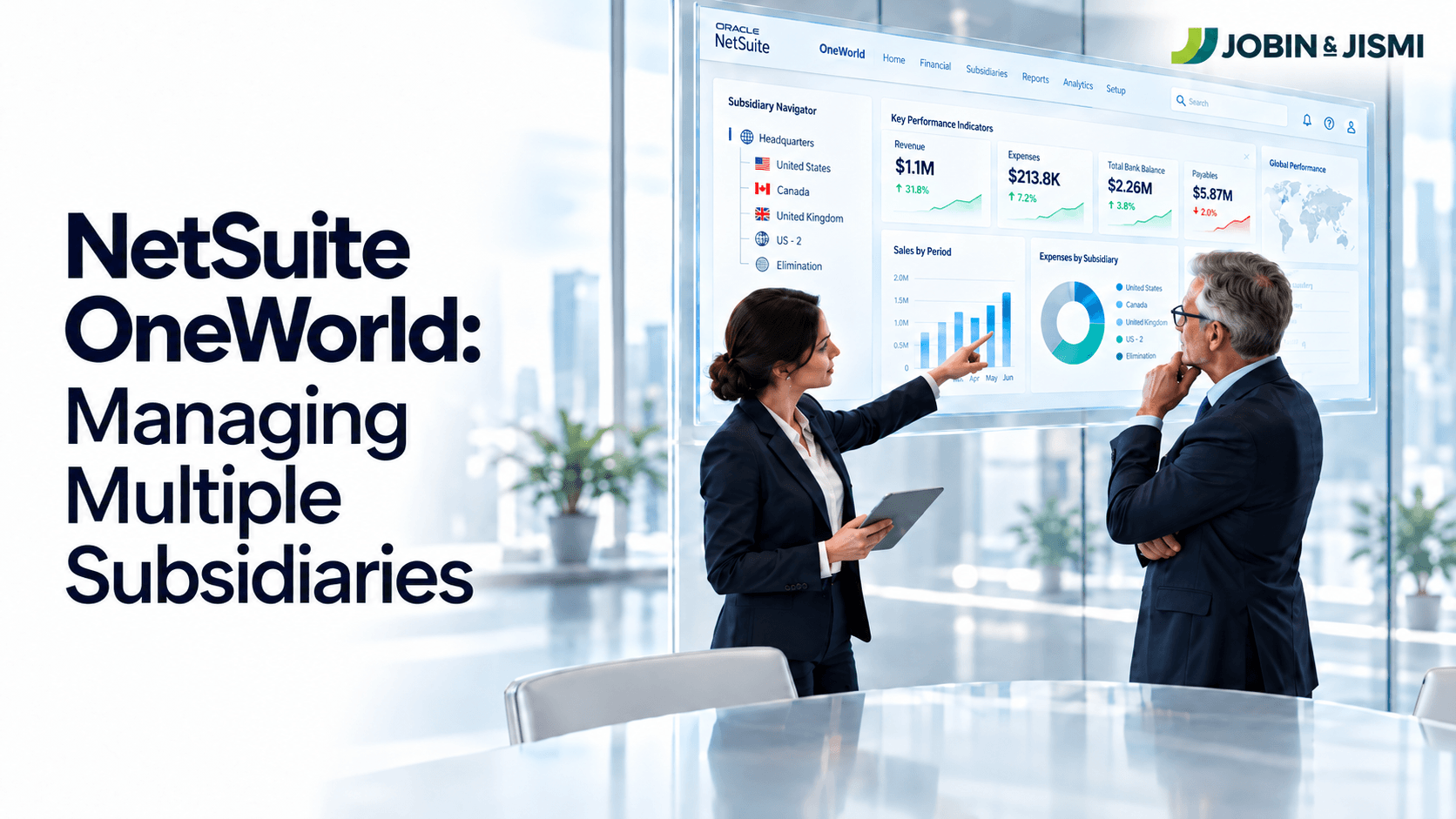
NetSuite OneWorld supports multi-entity structures, multi-subsidiary consolidation, multi-currency management, tax compliance of various countries, intercompany automation, and global financial consolidation. This is particularly valuable for companies expanding internationally, as with Oracle NetSuite as the ERP backbone they do not need to bolt on new systems.
3. Unified Business Platform
Unlike heavily modular legacy environments, NetSuite delivers all business management solutions in a single cloud, including:
· Financial Management (GL, AP, AR, FA, Revenue Recognition)
· Order Management
· Inventory & Warehouse Management
· Procurement
· Demand Planning
· CRM
· eCommerce (SuiteCommerce)
· Professional Services Automation
· Manufacturing
Instead of separate systems for finance, CRM, and commerce, with NetSuite ERP businesses operate within a unified platform.
4. Faster Innovation Cycles
Cloud-native ERP platforms evolve continuously. NetSuite allows businesses to gain access to modern analytics, automation tools, and AI-driven insights without any disruptive upgrade projects.
SAP ECC vs Oracle NetSuite: What’s the Real Difference?
Rather than debating marketing claims, here is a practical side-by-side comparison that reflects real-world implementation differences.
Quick Structural Difference
SAP ECC is a legacy, infrastructure-dependent ERP platform built for on-premise environments.
Oracle NetSuite is a multi-tenant SaaS ERP designed for unified, cloud-based operations.
That architectural shift influences cost, flexibility, speed, and risk.
Criteria | SAP ECC | Oracle NetSuite |
| Architecture | Primarily on-premise, legacy architecture | True cloud-native, multi-tenant SaaS |
| Support Lifecycle | Mainstream support ends 2027, extended support ends 2030 | Continuous vendor-supported updates |
| Infrastructure | Customer-managed servers and database | Fully vendor-managed cloud infrastructure |
| Upgrade Model | Major upgrade projects required | Automatic biannual updates without downtime |
| Total Cost of Ownership | High due to infrastructure, BASIS resources, and maintenance | Predictable subscription-based pricing |
| Global Capabilities | Complex setup requiring configuration and add-ons | Built-in multi-entity and multi-currency support with NetSuite OneWorld |
| Customization | ABAP-heavy custom development | Highly customizable with SuiteCloud platform and low-code tools |
| Scalability | Hardware-dependent scaling | Elastic cloud scaling |
| Integration Capability | Uses IDocs and middleware-heavy integrations | REST APIs, SuiteTalk, and native connectors |
| Implementation Time | Often lengthy and complex (12–36 months common) | Faster modular deployment (typically 4–9 months for mid-market companies) |
| Innovation Delivery | Periodic enhancement packs | Continuous cloud innovation |
| Ideal Fit | Large enterprises deeply invested in the SAP ecosystem | Mid-sized, upper mid-market, multi-national, and scaling businesses |
| Reporting | Often dependent on external BI tools | Native real-time dashboards |
| User Interface | Traditional SAP GUI | Modern browser-based interface |
Where Does NetSuite Deliver Immediate Strategic Value?
For companies seeking phase 3 digital transformation without carrying legacy complexity forward, staying within ECC often prolongs technical debt. NetSuite ERP becomes compelling when organizations want:
· Cloud-first financial visibility
· Faster month-end close
· Real-time dashboards
· Multi-subsidiary automation
· Reduced IT overhead
· Subscription-based predictability
· Rapid deployment
For fast-growing manufacturers, distributors, SaaS providers, and multi-entity service firms, NetSuite eliminates the friction commonly experienced in ECC environments.
What Are the Common Migration Risks?
When ERP migrations fail, it is rarely because the software couldn’t perform. It is usually because the organization underestimated complexity. SAP ECC to NetSuite migration is not simply a technical move, it is a structural shift in how your business runs. Industry prognostics from Gartner predict that over 70% of ERP initiatives will fail to fully meet their business case goals by 2027, with key risk drivers linked to organizational change, data migration challenges, and misaligned executive engagement. The risks below are not theoretical, rather they are patterns to watch out for.
1. Data Complexity
Most SAP ECC systems have been operational for 10 to 20 years. What is in the system is not just data, but historical layering. The common realities inside the ECC environment include thousands of inactive vendor or customer records, duplicate master records, inconsistent naming conventions, custom fields no one fully documents anymore, and transaction tables bloated with irrelevant legacy records.
Migrating unrefined data into the new ERP does not solve inefficiencies, it imports them. Migration requires structured data cleansing and field -level mapping validation. Archival strategies for inactive records and data governance controls must be mastered. Also, validation testing must be done in parallel.
2. Replicating Old Customizations
One of the most expensive ERP migration mistakes is copying every legacy workflow into the new system. NetSuite operates on a configuration-first model. It encourages simplification. That architectural difference is an opportunity.
Instead of asking, “How do we rebuild this in NetSuite?” the better question is:
“Why did we need this in the first place?”
Organizations that treat migration as a redesign exercise typically experience faster ROI realization and lower long-term maintenance costs. Migration is an opportunity to modernize, not re-create technical over-dependency and debt. A smarter approach is to simplify approval chains, leverage NetSuite native workflows, automate the manual processes, and eliminate spreadsheet dependency.
3. User Adoption Gaps
Without structured change management the resistance from the users increases, thus creating productivity dips. Even high-performing ERP systems fail to deliver value when
user engagement is weak. This results in delays in the return of investment (ROI). Structured training must begin before go-live, not after. They must include:
· Role-based training programs
· Departmental super-users
· Transparent communication from executive sponsor
· Sandbox access for hands-on exposure
· KPI measurement tied to adoption benchmarks
ERP modernization is a behavioral transformation as much as it is a technical one.
4. Integration Risk
Integration oversight as a contributing factor in ERP underperformance. Many ECC environments connect to a web of external systems including CRM platforms, payroll applications, WMS solutions, EDI systems, and custom reporting databases. Migration introduces new API structures, middleware decisions, and data flow rules.
A comprehensive migration strategy should clearly define real-time vs scheduled data flows, the middleware architecture, error-handling procedures, with parallel integration testing. If the ERP works but integrations fail, business operations still suffer.
5. Unrealistic Timelines and Budget Compression
The pressure to migrate before 2027 is real. But urgency must not compromise governance. A rushed ERP migration often leads to incomplete discovery workshops, poorly defined scope boundaries, limited user involvement early on, insufficient testing cycles, data reconciliation issues, poor documentation, and go-live instability. A realistic SAP ECC to NetSuite migration timeline balances urgency with discipline.
Switching to NetSuite from legacy ERP typically takes 4–9 months for mid-market organizations and 9–15 months for multi-entity operations.
6. Weak Post-Go-Live Governance
Many organizations celebrate go-live as the finish line. In reality, it is the midpoint. ERP performance gains compound through ongoing optimization, dashboard refinement, automation expansion, and quarterly performance reviews.
Without post-go-live governance, user adoption declines and teams will find it difficult to use the new ERP, making manual workarounds creep back. Also, the enhancement backlogs stall. Sustainable ERP value requires structured oversight beyond just deployment.
Steps for a Smooth Transition to NetSuite
1. Conduct a Comprehensive System Audit
Identify:
· Active ECC modules
· Custom developments
· Third-party integrations
· Reporting dependencies
· Data structure integrity
Understanding the full system landscape, both technical and functional, prevents costly surprises and risk later.
2. Clean and Map Your Data
Before migration:
· Remove obsolete vendor/customer records
· Standardize naming conventions
· Validate master data integrity
· Archive irrelevant historical data
· Eliminate duplicates
· Map SAP fields to NetSuite records
Data quality determines the stability of the implementation of the ERP.
3. Re-Engineer Critical Processes
Migration is an opportunity to improve operations. Before switching to a new ERP, focus on removing the process/operational inefficiencies faced while using the legacy system. Simplify approval workflows, automate manual reconciliations, standardize procurement cycles, remove redundant steps, and align with the NetSuite’s leading practices.
4. Choose the Right Migration Approach
Organizations transitioning from legacy system typically evaluate three approaches:
· Big Bang Migration: All modules go live simultaneously. Faster overall timeline, but higher risk.
· Phased Migration: Modules transition sequentially (finance first, then supply chain, etc.). Lower disruption, extended timeline.
· Hybrid Approach: Core financials move first while other systems transition gradually.
The right approach depends on operational complexity, geographic spread, risk tolerance, and internal change capacity. Mid-sized organizations often prefer phased deployments.
5. Train Users Early and Often
Users must be given proper role-based training programs, department-specific workshops, and sandbox testing access. Post-go-live support frameworks are equally important. The right adoption is what drives return on investment.
6. Testing
Validate financial postings, inventory movements, intercompany eliminations, tax calculations, and the stability of the integrations. Verify the accuracy of reports and dashboards. User Acceptance Testing (UAT) is non-negotiable. Testing uncovers friction in the implementation, if any, before it impacts customers.
7. Monitor and Optimize Post-Go-Live
Migration does not end at go-live. After launching carefully monitor performance metrics, gather user feedback, and refine workflows. ERP maturity develops over time, and it is continuous improvement that ensures long-term ERP value.
Conclusion
SAP ECC served its purpose in a different era of enterprise technology. But today’s businesses demand cloud agility, real-time visibility, and integrated intelligence. Migrating from SAP ECC to Oracle NetSuite is not simply about replacing legacy infrastructure. It is about positioning the organization for scalable growth, operational efficiency, and long-term digital resilience.
SAP ECC migrations involve technical complexity, regulatory considerations, and cross-departmental change management. An experienced ERP solution provider can help make the transition a success.
Connect with Jobin & Jismi’s expert team now and switch to Oracle NetSuite, to reduce your uncertainty and accelerate the value realization.
FAQ
What happens if we stay on SAP ECC after 2030?
You assume full responsibility for system security, compliance updates, and maintenance. Risk exposure rises significantly.
Is NetSuite a complete replacement for SAP ECC?
For most mid-market and upper mid-market companies, yes. It covers financials, inventory, CRM, manufacturing, and global operations within a unified cloud platform.
How long does migration typically take?
Most mid-sized organizations complete transition within 4–9 months, depending on complexity.
Can SAP ECC data be migrated directly?
Yes, the data can be migrated directly, but only after proper cleansing, restructuring, and field mapping.
Is it better to migrate all modules from SAP to NetSuite at once?
Phased deployments generally reduce business disruption and financial risk.
What are the estimated costs and timeline for migrating from SAP ECC to NetSuite?
Estimated costs and timelines for migrating from SAP ECC to NetSuite vary by company size, data complexity, customizations, and modules needed, but benchmarks provide solid guidance. Data volume, third-party integrations, and user training accelerate or delay timelines. At Jobin & Jismi, we optimize for faster ROI through proven NetSuite expertise tailored to Indian and global clients.
on LinkedIn