

AI Native ERP vs. Custom AI Integration: How Should Businesses Choose?



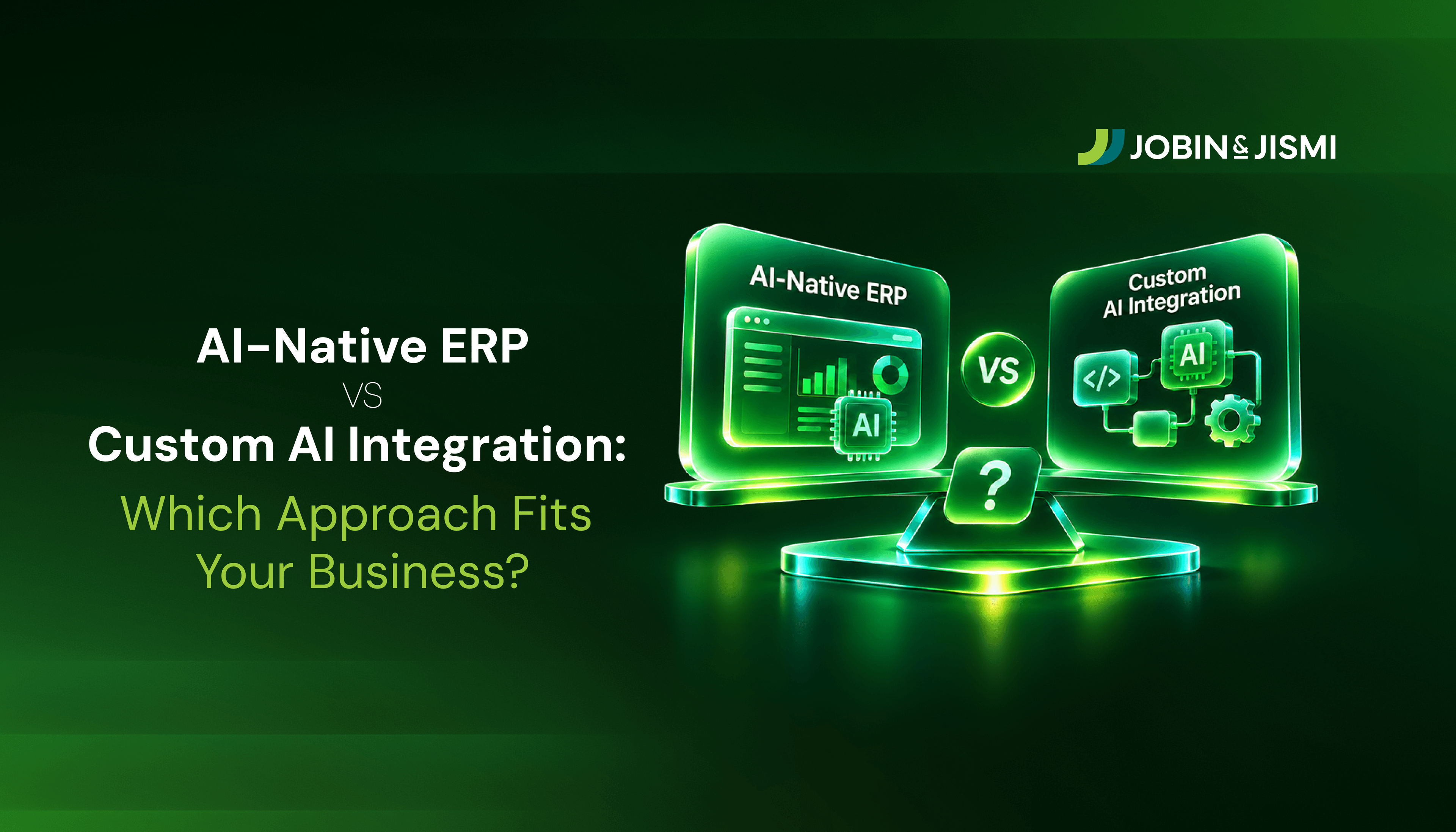
Businesses adopting artificial intelligence must decide whether to use capabilities built into an ERP platform or connect external AI services to their existing applications. This guide is written for CFOs, COOs, IT heads and founders weighing that decision. AI-native ERP incorporates intelligence into the platform's architecture and workflows, while custom AI integration extends existing systems with specialized AI capabilities. The decision depends on the business processes involved, the limitations of current systems, implementation costs and long-term technology requirements.
What Is an AI-Native ERP System?
An AI-native ERP system is an ERP platform designed with artificial intelligence as a core part of its architecture. Instead of treating AI as an add-on, these platforms build AI capabilities into their applications, data environment and business workflows. AI functions can then work with information managed across finance, inventory, procurement and other operations.
Depending on the platform, employees use natural-language queries to retrieve financial information, receive recommendations based on operational data, or use AI agents to assist with selected tasks. Oracle NetSuite is one example of this direction. Oracle announced NetSuite Next at SuiteWorld in October 2025 and describes it as the next generation of NetSuite that "puts AI at its core", combining a unified data model with explainable, auditable AI.
AI-native ERP systems differ from traditional ERP platforms that offer AI-assisted features. An established ERP may include predictive analytics, document processing or an AI assistant without having been designed around AI from the outset. Both models can deliver value. The difference lies in how closely the AI is tied to the platform's data and workflows.
How Do AI-Native ERP Systems Support Business Operations?
AI-powered ERP solutions bring intelligent capabilities into the business processes managed within an ERP platform. Their applications vary by vendor and product, but commonly include:
- Financial management: AI assists with transaction analysis, flags unusual patterns and prepares summaries of financial information.
- Inventory management: Predictive capabilities analyze historical sales, stock movements and demand patterns to support inventory planning.
- Procurement: AI reviews supplier information, processes purchasing documents and identifies patterns in procurement activity.
- Business reporting: Natural-language interfaces help employees retrieve information and interpret operational reports without relying entirely on manually prepared queries.
- Workflow management: AI identifies exceptions, suggests next steps and assists with selected repetitive activities.
What Is Custom AI Integration in ERP Systems?
Custom AI integration connects external AI models and services with a business's existing ERP and other applications. Rather than replacing the entire enterprise system, this approach introduces AI capabilities into selected workflows. The quality of the integration architecture matters most when business information is spread across several applications.
IBM's 2025 CEO Study, which surveyed 2,000 CEOs across 33 countries between February and April 2025, found that 50% said the pace of recent investment had left their organization with disconnected, piecemeal technology. In the same study, 68% identified integrated enterprise-wide data architecture as critical for cross-functional collaboration, and CEOs reported that only 25% of AI initiatives had delivered the expected ROI over the past few years. For any business planning custom AI integration, the message is clear: how AI services access and exchange data across existing systems shapes the return.
Several technologies can support custom AI integration:
- Application programming interfaces (APIs): Enable the ERP and external applications to exchange information and trigger supported actions.
- Middleware and integration platforms: Coordinate data exchange between applications, manage system connections and support workflow execution.
- Retrieval-augmented generation (RAG): Connects an AI model to approved business information, so it generates responses using relevant internal documents and records.
- Model Context Protocol (MCP): An open standard that lets AI assistants and agent platforms work with business applications through defined tools, with access governed by the application's own permissions.
The choice of integration method depends on the applications involved, the required data access and the complexity of the workflow. For NetSuite AI integration, Oracle offers the NetSuite AI Connector Service, a protocol-driven integration service that supports MCP and connects AI tools such as Claude and ChatGPT to NetSuite. These tools are governed by NetSuite's role-based security model, so users and the AI models they work with only see and access what their role permits.
AI-Native ERP vs. Custom AI Integration: Key Differences
AI-native ERP systems build intelligence into the ERP platform, while custom AI integration connects external AI services to existing applications. The main differences relate to architecture, implementation, flexibility, data access and ongoing maintenance. In practice, the built-in ERP AI vs custom AI solutions question is a trade-off: built-in AI reduces integration effort and keeps most dependencies with one ERP provider, while custom integration offers more choice of AI services in exchange for more integration work, monitoring and vendor relationships.
Evaluation factor | AI-native ERP | Custom AI integration |
Architecture | AI is incorporated into the ERP's foundational architecture. | External AI services connect with existing business applications. |
Primary purpose | Supports AI-driven capabilities within ERP operations. | Extends AI functionality across existing applications and workflows. |
Implementation | Depends on ERP deployment, configuration and supported functionality. | Requires integration architecture, application connectivity and workflow configuration. |
Customization | Depends on the ERP provider's supported capabilities. | Allows greater flexibility in selecting AI services and defining workflows. |
Data access | Works with the ERP's supported data environment. | Requires controlled access to information across connected applications. |
Maintenance | Primarily depends on the ERP provider and platform updates. | Requires monitoring of integrations, APIs and external AI services. |
Dependencies | Relies largely on the ERP provider. | May involve ERP vendors, AI providers and integration platforms. |
When Should Businesses Choose AI-Native ERP?
AI-native ERP is worth considering when businesses want AI capabilities built into their core enterprise environment rather than managed through several separate applications. This approach is particularly relevant for businesses evaluating a new ERP platform or planning a major ERP replacement. When comparing ERP implementation solutions, decision-makers should add AI to the selection criteria: which features are generally available in their region today, which are still on the roadmap, and how the AI respects existing roles and permissions.
Common requirements that may benefit from native ERP AI include:
- Financial reporting and transaction analysis: Finance teams use supported AI capabilities to examine financial information, identify unusual patterns and prepare management summaries within the ERP environment.
- Inventory and demand planning: AI-assisted forecasting helps businesses interpret historical demand, inventory movements and purchasing patterns when the platform supports these functions.
- Document processing: Built-in AI features extract information from invoices, purchase orders and other business documents.
- Business information retrieval: Natural-language interfaces help employees retrieve operational information and understand business reports through conversational queries.
- ERP workflow assistance: Available AI features assist with exception identification, task recommendations and selected activities within existing business processes.
Can Businesses Combine AI-Native ERP with Custom AI Integration?
Yes. Businesses can combine AI-native ERP systems with custom AI integration to address different operational requirements. Native ERP features support routine activities such as financial analysis and inventory planning, while external AI services extend these capabilities across connected applications. Businesses can also introduce custom AI models when standard AI-powered ERP solutions and external services cannot meet specialized requirements.
Oracle NetSuite reflects this hybrid model. NetSuite Next includes a built-in AI assistant, Ask Oracle, for navigating, searching, analyzing and acting on NetSuite data in natural language. Alongside it, the NetSuite AI Connector Service follows a "bring your own AI" model, so businesses can work with the AI tools of their choice without being tied to a single AI vendor.
A hybrid approach gives businesses flexibility, but it requires clear data access controls, defined integration responsibilities and human approval processes.
J&J Implementation Observation
In a recent NetSuite engagement, a client managing inventory against a four-month factory lead time wanted AI to sharpen reorder planning. The requirements were specific: adjust baseline demand for past stockout periods, flag one-off bulk orders as spikes, recognize seasonal patterns and respect factory minimum order quantities. Our team mapped each requirement to the NetSuite data it needed, designed and tested prompts against the client's data, and then developed vendor-based forecasting that feeds restock summaries and purchase order creation inside NetSuite. The pattern we see is consistent: custom AI integration delivers most when it extends a defined ERP workflow rather than running beside it.
What Should Businesses Evaluate Before Implementing ERP AI Solutions?
Data readiness should be assessed before selecting an AI implementation approach. Businesses need to determine whether information is accessible across their ERP and connected applications and whether AI services can reuse it reliably. Deloitte's Tech Trends 2026 report cites a 2025 Deloitte survey in which nearly half of organizations named searchability of data (48%) and reusability of data (47%) as challenges to their AI automation strategy (Source: Deloitte Insights, Tech Trends 2026). These findings reinforce the need to evaluate data accessibility and integration requirements before implementation.
Not every process needs AI. Where business rules are stable and predictable, customized ERP automation for business workflows, such as approval routing or scheduled scripts, may achieve the outcome at lower cost and risk. We group the remaining checks into the ERP AI Fit Assessment: eight factors to review before committing to AI-native ERP, custom AI integration or a mix of both.
Evaluation factor | What businesses should assess |
Business requirements | Whether the process needs conventional automation, standard AI capabilities or specialized intelligence. |
Data readiness | Availability, accuracy, consistency and accessibility of the information required by the AI application. |
Implementation complexity | Configuration, API development, middleware, model development and deployment requirements. |
Total cost of ownership | Licensing, API consumption, infrastructure, development, monitoring and maintenance expenses. |
Security and governance | Data privacy, permissions, encryption, auditability and human approval controls. |
Scalability | Ability to support increasing data volumes, user requirements and operational workloads. |
Maintenance | Responsibility for integration monitoring, model updates, troubleshooting and retraining. |
User adoption | Compatibility with existing workflows, employee training and usability across departments. |
India Insight
For Indian businesses, any AI service that reads customer, employee or vendor personal data from the ERP falls within the scope of the Digital Personal Data Protection Act, 2023. Define what data each AI service may access, and who approves its actions, before go-live.
Choosing the Right AI Implementation Approach
The AI-native ERP vs. custom AI integration decision depends on the capabilities required, existing technology and business priorities. AI-powered ERP solutions provide built-in intelligence for core operations, while custom AI integration extends AI functionality across existing applications, and many businesses will use both. The right AI implementation solutions address specific operational challenges without adding unnecessary systems or technical complexity. Jobin & Jismi, helps businesses integrate AI with your ERP and other business applications and develops custom AI solutions for businesses whose requirements standard services cannot address.
Explore how AI integration and custom AI development can support your business processes. Visit Jobin & Jismi's AI Services to discuss an implementation approach suited to your existing systems and operational requirements.
on LinkedIn

Frequently Asked Questions
AI-native ERP builds artificial intelligence into its core architecture, data model and workflows. Traditional ERP primarily manages business operations and offers AI through additional features, integrations or third-party applications. Oracle, for example, describes NetSuite Next as a next generation of NetSuite that puts AI at its core, with each insight and action governed by the user's existing roles, permissions and policies.
Yes. Custom AI solutions can connect with existing ERP software through APIs, middleware, integration platforms or the Model Context Protocol (MCP), so businesses can add AI capabilities without replacing their current ERP. Data quality decides how well this works.
Yes, provided its features, licensing costs and implementation requirements align with the business's needs and budget. Small and medium-sized businesses should check which AI capabilities are available in their region today and whether they justify the investment.
Yes. Businesses can connect generative AI services with NetSuite through the NetSuite AI Connector Service, which supports the Model Context Protocol (MCP) and works with AI tools such as Claude and ChatGPT, as well as through NetSuite's supported APIs and integration tools. AI access through the connector follows NetSuite's role-based permissions, so the AI only sees what the user's role allows. The right approach depends on the use case, data access requirements and security controls.
Yes. Custom AI integration can extend an existing ERP by connecting external AI services to specific workflows. It suits cases where the required functionality is not available within the ERP or depends on data from several business applications. IBM's 2025 CEO Study found that 50% of CEOs reported disconnected, piecemeal technology after rapid investment, which is exactly where a well-planned integration architecture matters most.