

Why AI Projects Fail: 7 Data Challenges & How to Overcome Them



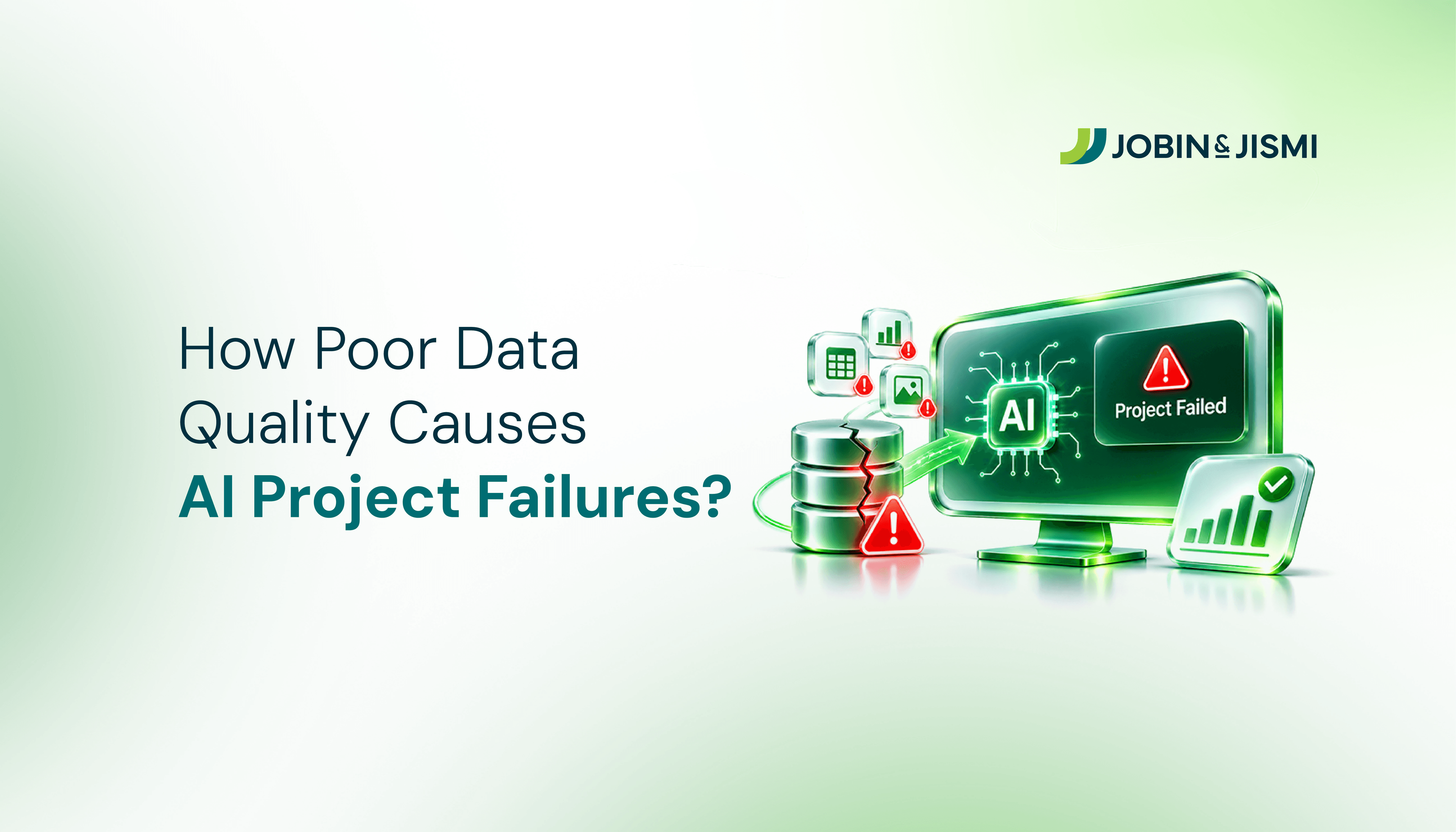
Most AI project failures trace back to data, not to the model. Even a capable AI system can produce unreliable results when business data is incomplete, inconsistent, or disconnected across applications. This article is written for finance, operations, and technology leaders planning AI on top of their ERP and business data. It explains why data quality matters, the seven data challenges in AI implementation that most often lead to AI project failures, and the practical steps that build data readiness for AI before deployment.
Why Does Data Quality Matter for AI Project Success?
Data quality directly affects the accuracy and reliability of AI systems. When business data contains missing records, outdated information, or inconsistent values, AI models produce inaccurate predictions and recommendations. Establishing data readiness for AI, often through a structured AI readiness assessment, helps businesses identify these issues before deployment. It involves validating data accuracy, checking completeness, standardizing formats, and ensuring relevant information is accessible across business applications. Addressing these data challenges in AI implementation helps reduce misleading outputs and gives business leaders greater confidence in AI-supported decisions.
The cost of skipping this work shows up early. Gartner predicts that through 2026, organizations will abandon 60% of AI projects unsupported by AI-ready data. RAND Corporation's 2024 research report on why AI projects fail lists a lack of sufficient high-quality data among the leading root causes, alongside underinvestment in data and deployment infrastructure.
The gap is wider for Indian businesses. Dun & Bradstreet's Q4 2026 AI Momentum Survey found that only 3% of surveyed Indian businesses describe their enterprise data as fully ready to support AI at scale, compared with 8% globally. Another 44% describe their data as only partially ready.
7 Data Challenges That Can Cause AI Projects to Fail
The seven AI project challenges below are the ones that most often surface when a business moves from an AI idea to a working deployment. Each starts with data, which is why these AI implementation challenges rarely get solved by switching to a different model or tool.
1. Incomplete Business Records
Missing sales transactions, customer information, or supplier records can prevent AI systems from analyzing the full business situation. A demand forecasting model that excludes sales from certain channels may underestimate demand, leading to inaccurate inventory planning and purchasing decisions. The model has no way of knowing the records are missing, so it treats the gap as low demand.
2. Inconsistent Data Across Systems
Business applications may use different customer identifiers, product classifications, currencies, or reporting definitions. Without reconciliation, AI can incorrectly combine records or compare incompatible information, affecting financial analysis, customer insights, and operational recommendations. In ERP environments, a common source is duplicate customer, vendor, or item records created before duplicate detection rules and numbering standards were put in place.
3. Limited Data and AI Expertise
AI implementation requires a combination of technical knowledge and business understanding. Shortages in areas such as data engineering, machine learning, model evaluation, and AI integration affect development decisions and delay deployment. Businesses also need employees who understand how to use AI outputs within their roles. Technical capability alone is insufficient if users cannot interpret or apply the results.
Adoption matters as much as capability. Limited training, unclear processes, and concerns about changing roles can slow adoption and reduce the value of the implementation. Clear communication, practical training, and ongoing support throughout the transition help users trust AI outputs and act on them.
4. Disconnected Business Applications
When ERP, CRM, eCommerce, and warehouse systems do not share data, each AI use case sees only part of the business. A collections model that reads ERP invoices but not CRM account notes, for example, cannot tell a disputed invoice from a slow payer.
The gap is often organizational as well as technical. Involving business stakeholders alongside data science and IT teams helps align AI development with operational objectives and strategic priorities. Continuous engagement throughout the project lifecycle supports use case validation, outcome assessment, and successful integration into established workflows.
5. Insufficient Testing and Production Readiness
Many AI pilots succeed on a clean, hand-prepared data extract and then struggle on live data. Production records carry exceptions the pilot never saw: partial shipments, credit notes, manual journal adjustments, and fields entered in different formats by different teams. Testing should use representative production data, include known edge cases, and define acceptance thresholds before go-live. Regression tests should run again whenever the model, the prompts, or the structure of the source data changes.
J&J Implementation Observation
On an AI-powered recruitment platform we built for an India-based career services client, response quality was treated as a data problem from the start. The delivery team added a central validation layer that checks every AI response against a defined schema, flags incomplete or hallucinated output, and enforces role-based data access, backed by evaluation datasets used for regression testing across model versions.
6. Limited Transparency and Governance
When AI systems operate without clear visibility into how decisions are made, troubleshooting errors and maintaining accountability become challenging. Businesses should establish governance frameworks that include access controls, human oversight, audit trails, and clear ownership of AI-driven decisions. The level of governance should align with the risk and impact of the use case.
7. Insufficient Data Validation and Monitoring
Data quality problems can remain undetected when businesses do not regularly validate records or monitor the information flowing into AI systems. Duplicate transactions, invalid values, unexpected changes in data formats, and failed integrations may affect AI outputs even after a successful initial deployment. Automated quality checks, pipeline monitoring, and clear exception-handling procedures help businesses detect these issues and prevent unreliable information from being used without review.
The table below summarizes each challenge, its typical business impact, and the first check to run.
Data challenge | Typical business impact | First check to run |
Incomplete business records | Understated demand, wrong purchasing and inventory decisions | Compare record counts by channel, location, and period against source systems |
Inconsistent data across systems | Wrongly merged or mismatched customers, items, and currencies | Run duplicate and identifier-matching reports across ERP, CRM, and eCommerce |
Limited data and AI expertise | Slow deployment and low user adoption | Name the data owner, AI owner, and business user for each use case |
Disconnected business applications | AI sees only part of the transaction history | Map which systems hold each data element the use case needs |
Insufficient testing and production readiness | Pilot results that do not hold on live data | Test on representative production data with defined acceptance thresholds |
Limited transparency and governance | No audit trail for AI-supported decisions | Confirm access controls, human review points, and decision ownership |
Insufficient data validation and monitoring | Output quality that drifts after go-live | Set automated quality checks and integration failure alerts |
How Can Businesses Overcome Data Challenges Before AI Implementation?
We group the fixes into five steps. Each step closes one or more of the challenges above, and together they form the core of an AI readiness assessment.
1. Define Data Requirements for the AI Use Case
Identify the information the AI solution needs to perform its intended task. A demand forecasting model may require sales history, inventory levels, and supplier lead times, while a customer service assistant may need customer records, order details, and service policies. Map each required data element to its source system, responsible owner, update frequency, and known quality limitations. This assessment also helps determine whether the proposed use case is suitable for AI business process automation.
2. Profile and Validate Data Quality
Check available records for missing fields, duplicate entries, outdated values, and inconsistent formats. Resolve issues that could affect AI outputs, such as mismatched customer IDs or incorrect transaction details. Not every anomaly is an error, though. A sudden increase in sales, for instance, may reflect a genuine bulk order rather than a data error, and validating such information with the business owner helps prevent useful patterns from being lost during data preparation.
The stakes are measurable. PwC's 2026 Digital Trends in Operations Survey of 767 US operations and supply chain executives found that 87% say poor data quality has hampered their progress in achieving value from digital initiatives.
3. Integrate Data Across Business Systems
AI applications often need information from ERP, CRM, eCommerce, and warehouse management systems. Integration should preserve the relationships between records and maintain consistent business definitions across applications. Establish shared identifiers for customers, suppliers, products, and transactions. For instance, for businesses exploring NetSuite AI integration, this means ensuring that relevant ERP information can be accessed by connected AI applications without losing its business context.
Oracle NetSuite now provides a governed route for this. The NetSuite AI Connector Service, built on the Model Context Protocol (MCP), connects external AI assistants to NetSuite data while applying NetSuite's existing role-based permissions, so an AI tool sees only what the user's role allows. Oracle also prevents the connector from running under the Administrator role, which means access has to be granted through a purpose-built role.
J&J Process Note
On NetSuite implementations, our consultants configure duplicate detection rules (prevent, warn, or merge) for customers, vendors, contacts, and leads, along with currencies, units of measure, and auto-generated numbering for entities and transactions, in the sandbox before anything moves to production. Clean master data at this stage is what later makes AI use cases on top of NetSuite reliable.
4. Establish Data Ownership and Governance
Assign clear ownership for critical datasets, including responsibility for quality, access, and maintenance. Define policies for sensitive information, data retention, and permitted use. Governance should also cover the information used for model training and retrieval. Maintaining data lineage helps teams trace the sources behind AI outputs and investigate errors when they occur.
India Insight: DPDP Act and AI Data
The Digital Personal Data Protection Rules, 2025, notified in November 2025, bring India's Digital Personal Data Protection Act, 2023 into force in phases, with most substantive obligations, including consent notices, applying from May 2027. Customer, employee, and vendor contact records used to train or ground AI models are likely to fall within scope where they contain digital personal data. Businesses preparing AI datasets now should record the purpose of each dataset, confirm its consent basis, and apply retention limits, with legal review for higher-risk use cases.
5. Monitor Data Quality After Deployment
Data quality can change as business processes and applications evolve. Monitor source data, integration failures, outdated records, and unexpected changes that could affect AI performance. An AI readiness assessment can help businesses identify these gaps before implementation. Addressing them early reduces avoidable AI project challenges and supports more reliable deployment. With the right data foundation, custom AI solutions for business needs and appropriate AI implementation services can be aligned with actual operational requirements.
How Does Proper Data Preparation Improve AI Project Outcomes?
Proper data preparation gives AI systems a reliable foundation for producing relevant and consistent results. When data is accurate, consistent, and accessible, AI models can identify meaningful patterns and generate outputs that better reflect actual business conditions. This improves the reliability of tasks such as demand forecasting, customer analysis, and financial reporting.
The return shows up in the numbers. Dun & Bradstreet's Q4 2026 AI Momentum Survey found that Indian businesses with fully AI-ready data report broad or strong AI ROI at 6.3 times the rate of those whose data is only partially ready.
Data preparation also reduces rework during implementation. Identifying missing records, resolving inconsistencies, and connecting relevant systems early prevents delays during testing and deployment. Combined with a structured AI readiness assessment and suitable AI implementation services, data preparation reduces avoidable AI project failures and creates a stronger foundation for reliable business outcomes.
When Should Businesses Consider Custom AI Development?
Businesses should consider custom AI development when existing AI tools cannot adequately address their operational requirements, data structures, or business processes.
Custom AI development may be suitable when:
- Existing solutions have functional limitations: Standard AI tools cannot support specific business rules, workflows, or industry requirements.
- Business data requires specialized processing: Information from multiple applications needs to be interpreted and processed according to business-specific requirements.
- Existing applications require deeper integration: Businesses need AI capabilities connected to ERP, CRM, eCommerce, or other enterprise systems.
- AI business process automation involves complex workflows: Standard automation tools cannot adequately manage multiple dependencies, exceptions, and decision-making requirements.
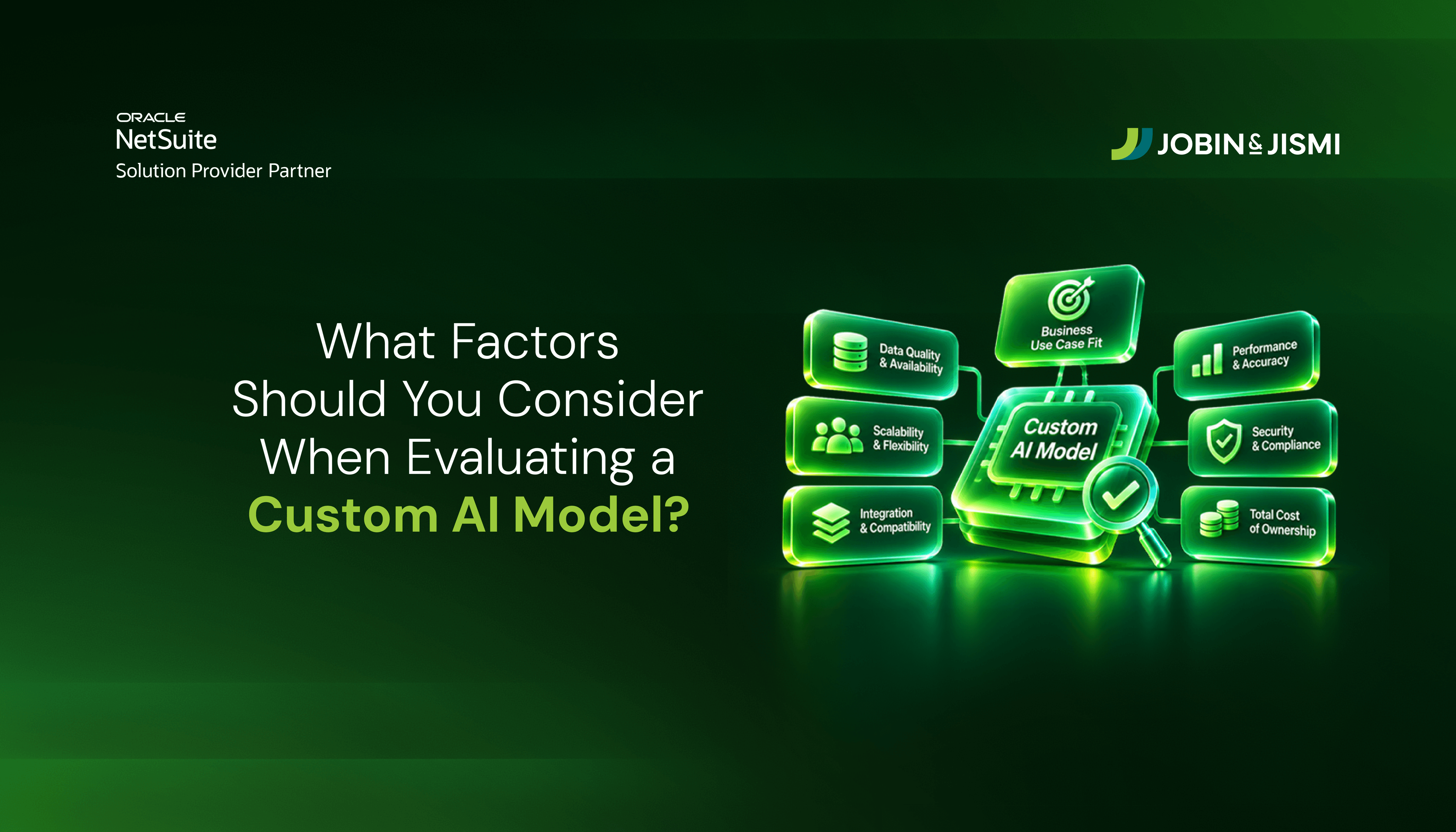
Custom development does not replace data preparation. A custom model trained on inconsistent records inherits the same problems as an off-the-shelf one. When these requirements justify a tailored solution, experienced AI implementation services help businesses develop custom AI solutions for business needs that align with their operational processes and technology environment.
Is Your Business Data Ready for AI?
AI project success depends on more than selecting the right technology. Most AI project failures begin with incomplete, inconsistent, or disconnected business data, which undermines AI accuracy, delays implementation, and reduces the reliability of business decisions. An AI readiness assessment is a practical starting point for identifying critical data gaps and determining whether existing AI capabilities or custom development best meet business requirements.
Certified in the Claude Partner Network and backed by deep Oracle NetSuite expertise, Jobin & Jismi helps businesses evaluate AI readiness, address data integration challenges, and implement AI solutions aligned with their operational needs.
Is your business data ready to support reliable AI outcomes? Talk to Jobin & Jismi to assess your AI readiness, identify data and integration gaps, and determine the right AI implementation approach for your business.
on LinkedIn

Frequently Asked Questions
Poor data quality reduces the accuracy of AI outputs and delays implementation. Missing, duplicate, or inconsistent records lead models to produce unreliable predictions, and teams then spend time correcting data that should have been fixed before deployment..
Data integration brings information from different business systems into a connected and consistent view. It helps AI systems access relevant information across applications, reducing data silos and supporting more reliable outputs.
AI can work with some incomplete data, depending on the use case and the extent of the gaps. However, missing information can affect model performance. Businesses should assess data gaps and determine whether they can be addressed through data collection, imputation, or other preparation methods.
Yes. Custom AI development can accommodate specialized data structures, validation rules, and integration requirements, but it does not automatically resolve inaccurate or missing information. Businesses still need data that is sufficiently reliable and relevant for the intended AI use case.
Businesses can improve data quality by starting with a specific AI use case, identifying the records and sources it requires, and then fixing missing or duplicate records, correcting inconsistent formats, validating accuracy, and integrating relevant information across systems. Establishing data ownership and governance also helps maintain quality.
When AI models are trained with inconsistent data, they may learn conflicting patterns and produce unreliable predictions or outputs. Differences in data formats, definitions, or values across sources can also affect model performance and make results harder to interpret.