

How to Evaluate a Custom AI Model Before Using It in Business Operations



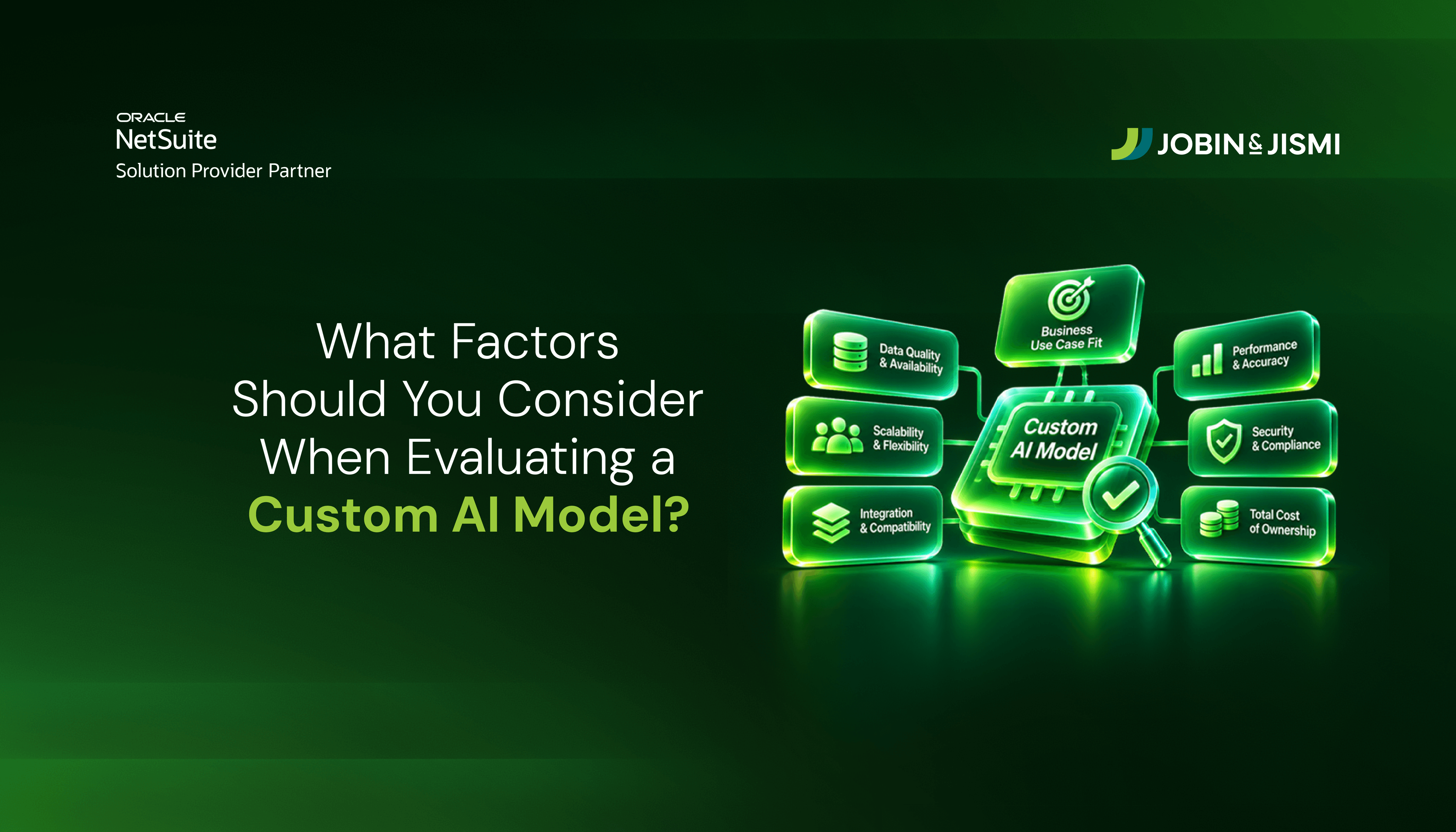
Quick answer
Custom AI model evaluation is the process of testing whether an AI model built for a specific business task performs accurately, consistently and securely on real business data before it goes live. A sound evaluation defines the use case, sets measurable acceptance criteria, tests the model on representative data and realistic scenarios, involves the employees who will use its outputs, and confirms that it works reliably with ERP, CRM and other business applications.
Custom AI models support business tasks such as demand forecasting, financial processing, predictive maintenance and decision support. However, a model that performs well during development does not always perform the same way in live operations. This guide is written for business leaders, finance heads and operations managers who are planning to deploy a custom AI model. It covers the metrics, testing stages, common mistakes and readiness checks that matter, so you can judge a model's performance, data quality, reliability, security and fit with your workflows before deployment.
What Is AI Model Evaluation?
AI model evaluation is the process of assessing how accurately, reliably and consistently an AI model performs the task it was designed to handle. It involves testing the model with relevant data, measuring its results against predefined criteria, and identifying limitations that could affect its use in business operations.
Custom AI model evaluation applies the same discipline to a model built around one organization's own data, rules and workflows. It considers several aspects of model quality, including accuracy, data quality, consistency, security and compatibility with existing business applications. It also examines the different types of errors the model makes and their potential impact on business decisions.
Data readiness is a central part of the assessment. Accenture's AI-ready data research (May 2026) found that more than 80% of surveyed organizations delay, limit or alter AI and generative AI initiatives at least occasionally because of data-related risks, and that only 7% had reached the level of data readiness needed to scale advanced AI. If your data foundations are still an open question, our guide How Do You Know If Your Business Is Ready for AI Implementation? is a practical place to start.
Why Should Businesses Evaluate a Custom AI Model Before Deployment?
Introducing an AI model into a business process without sufficient testing creates problems that become harder to detect once employees and downstream systems start relying on its outputs. Evaluation lets businesses find these weaknesses before they affect live operations, and it delivers four specific benefits.
Confirming whether the model meets business requirements
Evaluation shows whether a model can perform the task it was developed for. Its outputs should meet the required business rules, terminology, formats, decision thresholds and operational requirements, not just a general accuracy score.
Understanding the impact of model errors
Different errors have different business consequences. In fraud detection, a false negative may allow a suspicious transaction to go unnoticed, while a false positive may trigger unnecessary reviews of legitimate transactions. AI model performance evaluation should therefore consider the type of error, its potential impact and the level of accuracy the task actually requires.
Checking whether the model fits existing operations
A model may produce accurate results during testing and still create extra work if it cannot connect with existing business applications or handle the expected volume of data. Assessing its integration requirements, processing capacity and workflow compatibility shows whether it can operate as part of your wider AI automation solutions rather than as a separate tool that people work around.
Establishing how employees should use model outputs
Employees need to know when they can rely on an AI-generated output and when human verification is necessary. This matters most when model results influence financial records, customer commitments or operational decisions. McKinsey's November 2026 research on AI in business planning notes that most current deployments still involve AI making recommendations that require human approval. Defining these responsibilities early ensures that custom AI solutions for businesses fit the organization's workflows and risk tolerance.
Which Metrics Help Measure AI Model Performance?
The metrics used in AI model performance evaluation should reflect the model's intended application and the decisions it supports. This is especially important when assessing the reliability of AI-generated outputs. Stanford HAI's 2026 AI Index reported that hallucination rates across 26 models ranged from 22% to 94% on the AA-Omniscience factuality benchmark, a spread that shows why factual reliability has to be tested for your own use case rather than assumed. Businesses can assess model performance using the following measures:
- Precision and recall: Precision shows what share of the cases the model flags are actually relevant, while recall shows what share of all relevant cases the model detects. Both are useful for applications such as fraud detection, lead classification and transaction monitoring.
- F1 score: The F1 score is the harmonic mean of precision and recall, combining both into a single figure. It is useful for classification models where both false alarms and missed cases carry a business cost, because it helps teams choose a model that balances the two.
- Human evaluation: In generative AI applications, human reviewers assess whether outputs are factually supported, relevant, clear and useful for the intended task. This is particularly important for AI-generated summaries, recommendations and responses used by employees.
- Response time and processing capacity: These measures show how quickly a model returns results and how many requests it can handle in a given period. They confirm whether the model can support expected workloads once it runs inside business workflows.
- Cost per prediction: Cost per prediction measures the resources required to generate each output. Reviewing this cost at expected usage volumes shows the ongoing expense of operating the model.
No single metric is enough on its own. Agree the metric set and the threshold each metric must reach with the process owner before testing begins, so the results can be judged against a fixed standard.
How Can Custom AI Solutions Help Businesses Improve Operations?
Custom AI solutions for businesses address operational challenges by analyzing business-specific data, applying business rules and supporting decisions across existing workflows. Each application calls for a different evaluation focus. Key applications include:
- Demand and inventory planning: Analyze sales trends, stock levels and supplier lead times to anticipate shortages and shifts in demand. According to McKinsey's 2026 research on business planning, chemicals businesses where it tracked planning transformations improved forecast accuracy by 15 to 20 percentage points and reduced on-hand inventory by 20 to 30% in the first phase.
Evaluation focus: forecast error against the current planning method, tested across seasonal peaks and slow-moving items.
- Financial processing: Extract invoice details, compare them with purchase orders and flag discrepancies for finance teams to review.
Evaluation focus: extraction accuracy by field, the rate of missed discrepancies, and how exceptions are routed for review. - Predictive maintenance: Analyze equipment data and maintenance records to identify potential failures before they disrupt production.
Evaluation focus: recall on actual failure events, and the cost of false alarms that take equipment offline unnecessarily. - Management decision support: Bring together data from ERP, CRM and other business applications to highlight trends, exceptions and operational risks.
Evaluation focus: whether figures reconcile with the source systems, and whether summaries stay supported by the underlying data.
Common Mistakes to Avoid When Evaluating AI Models
Most evaluation failures come from how a model is tested rather than from the model itself. The table below sets out the mistakes that most often distort results and how to avoid each one.
Common mistake | Why it affects the assessment | How to avoid it |
Relying only on accuracy | A high score can conceal poor performance on less frequent but important cases. | Use metrics that reflect the task and the consequences of different errors. |
Testing with unrepresentative data | Results may not reflect the inputs the model meets in actual operations. | Include realistic data variations, incomplete records and edge cases. |
Allowing data leakage | The model may appear more accurate than it will be on unseen data. | Keep training, validation and test datasets properly separated. |
Ignoring business context | A technically correct prediction may not support the intended business decision. | Involve process owners when defining requirements and acceptance criteria. |
Depending only on automated scores | Metrics may not capture contextual errors or the usefulness of generated outputs. | Combine automated evaluation with domain-expert review where appropriate. |
Skipping integration testing | The model may perform well on its own but fail within the actual workflow. | Test application connections, data exchange and output handling. |
Treating a proof of concept as deployment approval | A limited demonstration does not establish performance under normal operating conditions. | Require evidence from representative testing and predefined acceptance criteria. |
Ignoring post-deployment monitoring | Performance may change as data and operating conditions evolve. | Set up monitoring and review procedures before implementation. |
How Can Businesses Test a Custom AI Model Before Implementation?
The following stages give a practical approach to assessing a model before it enters a live workflow.
Stage 1: Define the business use case. Identify the process the model will support, its intended users, the input data and the expected output. Clear requirements give the team a fixed basis for custom AI model evaluation.
Stage 2: Set evaluation criteria and baselines. Define acceptable performance levels based on the task and the impact of errors. Compare the model with the existing manual process, rule-based system or an alternative solution to establish its practical value.
Stage 3: Prepare representative test data. Use data that reflects actual business conditions, including incomplete records, varied formats and unusual cases. Check for duplicate records, incorrect labels and data leakage so the test results can be trusted.
Stage 4: Assess model performance. Run the model against the test dataset and measure its results with the agreed metrics. Review false positives, false negatives and inaccurate predictions to see where improvements are needed.
Stage 5: Test realistic business scenarios. Check how the model handles situations it will meet in daily operations, such as unfamiliar invoice formats, incomplete customer enquiries or sudden changes in demand. This shows how it behaves outside clean test conditions.
Stage 6: Conduct user acceptance testing. Involve employees who understand the business process in reviewing the outputs. Their feedback identifies usability issues, manual correction effort and situations where human approval is necessary.
Stage 7: Check operational readiness. Confirm that the model can connect with existing applications, data sources and APIs while meeting expected workload and response-time requirements. Security, maintenance and operating costs also need review before engaging AI implementation services for full deployment. A Gartner survey published in November 2025 of 360 organizations found that those performing regular audits and assessments of AI system performance and compliance were more than three times as likely to achieve high GenAI value as those that did not.
When Is a Custom AI Model Ready for Business Deployment?
A custom AI model is ready for business deployment when it meets the acceptance criteria agreed before testing, and when the people, systems and controls around it are ready too. In practice, the model is ready when each of the following is true:
- It meets the agreed thresholds for its key metrics on representative test data, not only on development data.
- The error types with the highest business impact have been reviewed and stay within agreed limits.
- Process owners have completed user acceptance testing and signed off on the outputs.
- Documented rules state when outputs can be used directly and when human approval is required.
- Integration with ERP, CRM and other applications has been tested at expected volumes and response times.
- Security and data-access controls are in place, and the model can reach only the data its role requires.
- A monitoring plan with named owners and review intervals is ready before go-live.
India Insight: Data protection is now part of readiness
For businesses in India, security and data handling carry a regulatory dimension. The Digital Personal Data Protection Rules, 2025, notified by the Ministry of Electronics and Information Technology in November 2025, bring the operative obligations of the DPDP Act, 2023, including security safeguards and personal data breach notification, into force in May 2027. Where a custom AI model processes customer or employee personal data, the evaluation should confirm how that data is accessed, stored and protected.
Turning AI Model Evaluation into Business Readiness
A custom AI model is ready for business use when it meets defined performance standards and works reliably within actual business processes. Custom AI model evaluation gives businesses a structured way to check data quality, accuracy, operational fit and integration requirements before deployment, and regular AI model performance evaluation after go-live catches changes as business data and requirements evolve.
Jobin & Jismi, certified in the Claude Partner Network, provides AI implementation services that help businesses develop custom AI models and integrate them with NetSuite and other business applications. Pairing careful evaluation with the right AI automation solutions lets businesses make informed decisions about adopting AI and apply custom AI solutions for businesses where they deliver measurable value.
Planning to implement a custom AI model? Connect with Jobin & Jismi to discuss your business requirements and the right approach to custom AI model development and integration.
on LinkedIn

Related Blogs
Frequently Asked Questions
A custom AI model is suitable when it addresses a clearly defined business problem, works with the data you actually have, and meets agreed accuracy and operational standards when tested against real business scenarios. Data is usually the deciding factor: Accenture's May 2026 AI-ready data research found that only 7% of surveyed organizations had reached the data readiness needed to scale advanced AI.
The metrics depend on the task. Classification models are usually measured with precision, recall and the F1 score, which together show how well the model balances false alarms against missed cases. Generative AI outputs also need human evaluation, because Stanford HAI's 2026 AI Index reported hallucination rates from 22% to 94% across 26 models on one factuality benchmark. Response time, processing capacity and cost per prediction show whether the model is practical at business volumes.
Yes. A custom AI model can connect with ERP and CRM systems through APIs, middleware or integration platforms, and the right approach depends on the systems involved, data access requirements and the business workflow. Oracle NetSuite, for example, offers the NetSuite AI Connector Service, which uses the Model Context Protocol (MCP) to connect external AI assistants to NetSuite while following NetSuite's existing role-based permissions.
An untested model may produce inaccurate predictions, generate unsupported information, expose sensitive data or make inconsistent decisions, affecting financial reporting, customer interactions and inventory planning. Data exposure also carries regulatory weight in India, where the DPDP Rules, 2025 bring security safeguard and breach notification obligations into force in May 2027.
Businesses reduce errors by using representative training data, testing outputs against defined criteria, introducing human review for high-impact decisions, and setting clear rules for handling uncertain results. Human review remains standard practice: McKinsey's November 2026 research on AI in business planning notes that most current deployments still involve AI recommendations that require human approval.
Yes. A custom AI model can be updated through retraining, fine-tuning, or changes to its data sources and integration logic, and every revised model should be evaluated again before redeployment. Ongoing assessment pays off: Gartner's November 2025 survey found that organizations regularly assessing AI system performance and compliance were more than three times as likely to achieve high GenAI value.