

How AI Solutions Can Personalize the NetSuite SuiteCommerce Shopping Experience



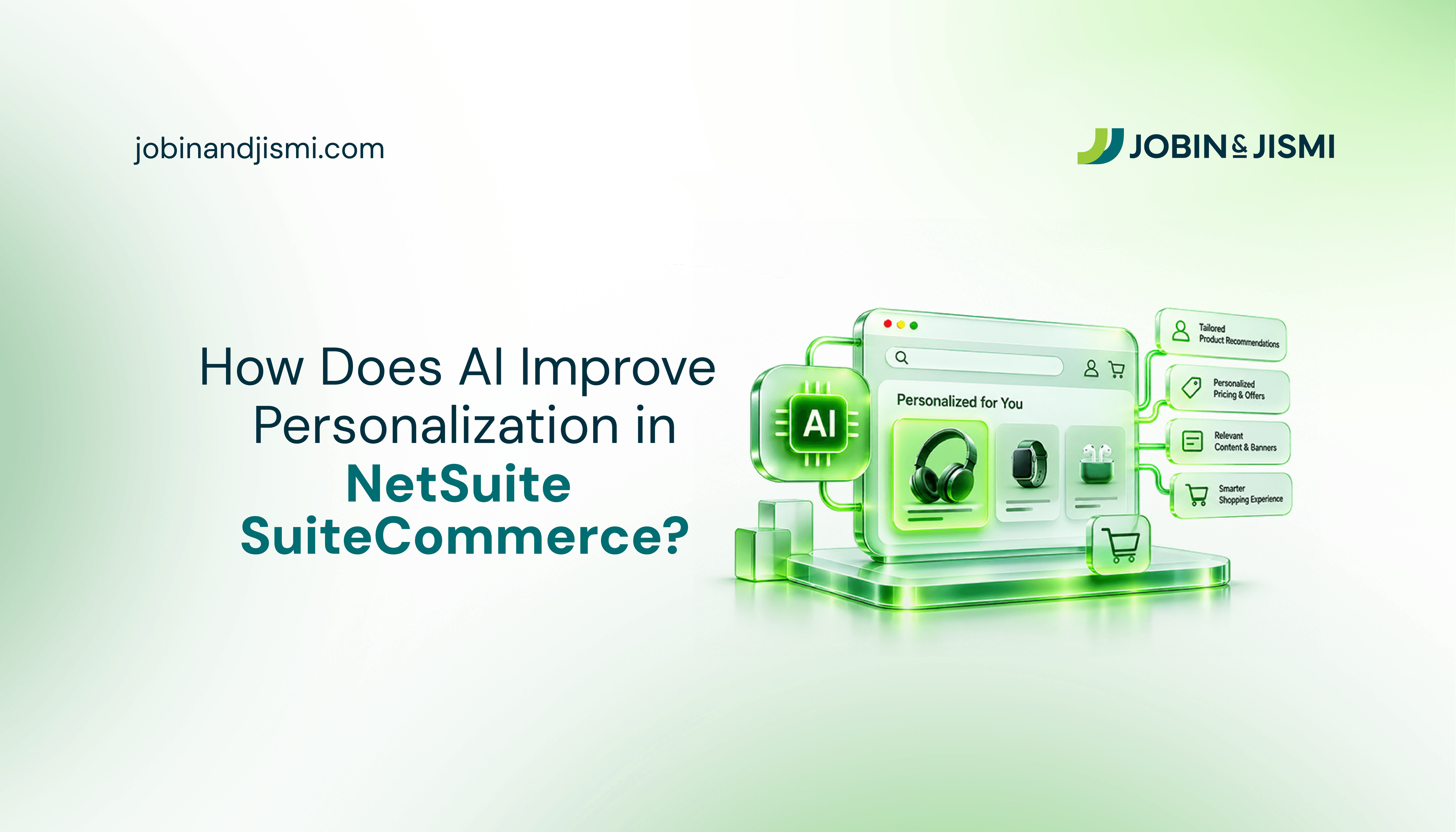
Consumer expectations give businesses a clear reason to consider personalization. According to the Qualtrics XM Institute report Consumer Preferences for Privacy and Personalization, 2025, 64% of consumers worldwide prefer to buy from companies that tailor experiences to their wants and needs. In India, that preference rises to 82%, the strongest of the 23 countries in the study. For businesses serving Indian customers, personalized digital shopping is a buyer expectation worth planning for.
NetSuite's native recommendation tools provide the starting point when evaluating AI for NetSuite SuiteCommerce, while NetSuite Next, AI agents and external applications offer additional ways to use business data to improve the shopping experience. For leaders comparing AI solutions for businesses that already run NetSuite, this article explains which capabilities are native, where custom work comes in, and what to check before investing.
What Is AI-Powered eCommerce Personalization?
AI-powered eCommerce personalization uses customer, product, transaction and behavioral data to make the shopping experience more relevant to each buyer. Within a SuiteCommerce environment, this can include surfacing products based on purchase history, making repeat purchases easier, improving product search, supporting complex product selection, or identifying customer needs from account activity. Some NetSuite tools provide insights to employees inside the ERP, while customer-facing personalization on the storefront may require native features, SuiteCommerce extensions, workflows or external integrations.
How Do AI Solutions Enhance the NetSuite SuiteCommerce Shopping Experience?
B2B buying is moving towards self-service. Gartner reported in March 2026 that 67% of B2B buyers prefer a rep-free experience, and 45% said they used AI during a recent purchase. When buyers prefer to research and order on their own, the storefront has to do more of the work a sales rep once did: surface the right products, remember what each account buys, and answer configuration questions.
Key AI Solutions That Personalize the SuiteCommerce Shopping Experience
- AI-Powered Product Recommendations: NetSuite's Intelligent Item Recommendations use AI algorithms to calculate and display items a customer is likely to want. The algorithms draw on past purchases, the purchases of similar customers, items bought together, and similarities in item names, descriptions and categories, and they learn from transaction data every 24 hours. Recommendation types include Customer Purchase History, Buy Again, Order or Cart Items and Customers Who Bought This Also Bought, which help customers find products based on previous orders and items commonly purchased together. A distributor that regularly orders industrial supplies sees suggestions that reflect its own buying pattern. Repeat ordering gets easier, and complementary products appear without the customer searching the entire catalog.
- NetSuite Next and Ask Oracle for ERP-side Commerce Insights: NetSuite Next brings conversational AI and contextual intelligence into the ERP environment through Ask Oracle. Authorized users can retrieve business information and analyze customer or sales data using natural-language prompts, within their existing roles and permissions. Oracle's 2026.2 release notes state that Ask Oracle can return the price level and exact unit rate the pricing engine selects for a customer purchasing an item, and compare prices across quantities or customers. These insights support better-informed customer conversations, particularly in B2B businesses with different pricing arrangements across accounts. Oracle began rolling out NetSuite Next with release 2026.2, starting with customers in the United States and Canada.
- SuiteAgents for Customer Analysis and Workflow Automation: SuiteAgents perform supported tasks against NetSuite data within configured role and permission boundaries. At SuiteWorld 2026, Oracle introduced more than 45 SuiteSkills, including Sales Assistant and Customer Support Assistant skills that draw on account and case information to prepare insights, responses and next steps for employees to review. Ther is also SuiteAgent Management workspace designed to show each agent's permissions and activity and record agent changes in System Notes. Businesses should confirm its release status before relying on it for governance.
- AI-Assisted Product Configuration Through NetSuite CPQ: NetSuite CPQ Configurator version 1.8.0, part of the 2026.2 release, introduces the CPQ AI Assistant, a generative AI tool that responds to natural-language prompts and guides sales reps and buyers through product and service configuration. Administrators prepare the product, question and answer records the assistant works from. A manufacturer selling industrial equipment may need buyers to select capacity, dimensions and components before placing an order, and the assistant guides users through those choices. Oracle describe the assistant within transactions, so offering similar guidance on the storefront calls for a SuiteCommerce Implementation review of commerce architecture and integration needs.
- AI-Powered Product Search and Custom Integrations: Standard keyword searches do not always help customers find products, particularly when they use different terms from those in the product catalog. External AI applications can interpret product descriptions, specifications and related terminology to improve search relevance. These AI-powered eCommerce solutions can also use browsing activity alongside purchase history to generate more relevant product suggestions. The SuiteCommerce Extensibility API provides the supported extension layer for adding customer-facing functionality to SuiteCommerce without changing the underlying application code. An external AI solution may also require SuiteScript, REST-based services or another integration mechanism to exchange data with NetSuite.
When Do Businesses Need Custom AI Solutions for eCommerce?
Intelligent Item Recommendations cover several transaction- and shopper-based recommendation scenarios. Oracle lists clear prerequisites: a SuiteCommerce or SuiteCommerce Advanced 18.2 or later website, Site Management Tools version 3 or later, at least 50 items in the website catalog and, for most types, a minimum number of transactions in the past 12 months. Requirements such as semantic product search, proprietary recommendation logic, or AI that combines NetSuite data with external behavioral data sit outside that scope and typically need additional development.
Manufacturers with complex product configurations and businesses with specialized pricing rules may also need capabilities beyond standard functionality. Custom AI solutions for eCommerce businesses address these requirements using existing data and commerce workflows. This is where AI development services for businesses add value: building on the item, customer and transaction records already in NetSuite rather than starting a separate data project.
J&J Implementation Observation
In our SuiteCommerce projects, the recommendation logic is rarely the hardest part. The work is in getting the output into NetSuite and onto the page. One US-based client had about 500 items with no related products assigned. A team member used an AI assistant connected to NetSuite to suggest which products belonged together, and the next question was how to load those relationships in bulk rather than item by item. On the same site, our team found that related items attached to matrix parent items were not returned to the product detail page, so the relationships had to sit on matrix child items or be exposed through a custom extension.
On another project, we built a custom Related Products record with relationship types such as Frequently Bought Together and Color Variant, with CSV import and duplicate checks, so the merchandising team could maintain recommendations at scale.
How Do You Integrate Custom AI Solutions with NetSuite SuiteCommerce?
eCommerce AI integration services typically work across three layers: the ERP data, the AI capabilities inside NetSuite, and the storefront where customers see the result.
Connecting ERP Data with AI Applications
Data access is the first hurdle. Deloitte's Global AI-Driven Organization Survey 2024, which covered more than 500 companies in 14 countries, found that 35% of organizations face difficulties accessing accurate, real-time data, while 33% find data cleansing and transformation a substantial challenge. NetSuite holds the customer, transaction, product, pricing and inventory data that AI-powered personalization depends on. Purchase history identifies recurring demand, while product information and pricing records support relevant recommendations and customer-specific experiences.
Using NetSuite Next and SuiteAgents in the Implementation
NetSuite Next and SuiteAgents extend AI capabilities within the ERP environment. Ask Oracle gives authorized users access to business information, and SuiteSkills such as the Sales Assistant prepare account insights for employees to review. Sales teams can use these insights to spot customers whose order activity has slowed and plan targeted follow-ups through connected CRM or marketing applications.
For businesses that prefer their own AI models, the NetSuite AI Connector Service uses the Model Context Protocol (MCP) to connect external AI clients to NetSuite. No users have MCP access by default, the permission must be granted to a role, MCP tools run with the same permissions as the NetSuite user, and all MCP tool usage is logged.
Extending SuiteCommerce Through APIs and Custom Integrations
For personalization requirements beyond standard NetSuite functionality, businesses often rely on AI integration services, third-party AI applications or SuiteCommerce customization services. NetSuite's SuiteCommerce Extensibility API provides a framework for connecting third-party recommendation engines, advanced search tools and other customer-facing applications through custom storefront extensions. The integration should define which NetSuite data and customer interactions are accessed, how often they refresh, and how they are used.
What Are the Benefits of AI Personalization for B2B and B2C eCommerce Businesses?
In SuiteCommerce, the practical value of personalization is reducing the effort required to find, reorder, configure or evaluate products relevant to a specific customer. B2B buyers gain most from account-specific reordering, pricing and configuration support. B2C shoppers benefit more from browsing-led suggestions such as Recently Viewed Items and Customers Who Bought This Also Bought, both listed among NetSuite's recommendation types. Across both, personalization can improve product discovery, support repeat orders and uncover opportunities within existing customer accounts.
Easier Product Discovery and Repeat Ordering
Customers browsing extensive product catalogs spend time searching for products they already know. Purchase-history recommendations make repeat buying easier by bringing previously ordered items back into view. Related-item recommendations can surface products frequently purchased together or alternatives identified from item data, depending on the recommendation scenario.
More Relevant Customer Engagement
SuiteSkills such as the Sales Assistant help sales teams prepare for customer conversations using account information, and Ask Oracle lets authorized users analyze customer and sales data in natural language. Teams can use these findings to decide which accounts need attention and where a targeted campaign may be appropriate.
Better Support for Pricing and Product Configuration
B2B buyers often expect prices and product options to reflect their account arrangements. Ask Oracle can help authorized employees retrieve customer-specific pricing information, while the NetSuite CPQ AI Assistant guides users through supported product configuration workflows. These capabilities help sales teams respond to pricing inquiries and product requirements with accurate information.
More Informed Commerce Decisions
NetSuite Next and SuiteAgents provide additional ways to analyze information within the ERP environment. A sales team might prioritize an account whose ordering frequency has declined, or review products frequently purchased alongside a particular item. The business value comes from acting on these findings, whether through a relevant customer recommendation, a sales follow-up or a targeted campaign.
What Should Businesses Consider Before Implementing AI Personalization in SuiteCommerce?
We use a four-step Native-First Personalization Check before recommending any custom build. Each step answers one question, in this order.
- Assessing Native NetSuite Capabilities: Review existing NetSuite features before investing in additional applications. Intelligent Item Recommendations, NetSuite Next, SuiteAgents and the CPQ AI Assistant address different requirements, but their availability and suitability for customer-facing personalization should be assessed first.
- Checking Data Readiness and Integration Requirements: Check whether customer records, purchase history, product details, inventory and pricing data are accurate and accessible. Also establish how browsing activity will be captured and how information will move between NetSuite, SuiteCommerce and external AI applications.
- Protecting Customer Information and Pricing: Set clear rules for how customer data and commercial information can be collected, processed and accessed, including which roles an AI tool runs under.
- Planning the Investment and Ongoing Maintenance: AI personalization requires ongoing investment in data quality, integration, testing and maintenance, not just application licenses. Businesses should establish baseline measures before implementation, such as product-search success, recommendation engagement, repeat-order completion and average order value. These measures show whether the additional development and maintenance costs are justified, and they give AI implementation services a clear target to deliver against.
India Insight
For storefronts serving Indian customers, the Digital Personal Data Protection Act, 2023 governs how personal data such as browsing and purchase history is collected and used. The Digital Personal Data Protection Rules, 2025, notified by the Ministry of Electronics and Information Technology in November 2025, phase in most data fiduciary obligations over 18 months. Personalization programs planned now should build consent capture and purpose limits into the design rather than add them later.
Looking to Personalize Your eCommerce Experience?
AI for NetSuite SuiteCommerce is most useful when it solves a defined buying problem, such as difficult product discovery, repetitive ordering, or the need to use customer and transaction data more effectively. The first decision is whether that requirement can be met with existing NetSuite capabilities or needs SuiteCommerce customization, an external AI application or a custom integration. Jobin & Jismi, an Oracle NetSuite Solution Provider Partner, works across NetSuite ERP, SuiteCommerce and AI integration to help businesses assess those options and define an implementation approach suited to their commerce architecture, data and operating requirements.
If you are evaluating SuiteCommerce customization, AI implementation services or a custom AI integration, contact Jobin & Jismi to review the requirement and determine which capabilities should remain standard and where additional development is justified.
on LinkedIn

Frequently Asked Questions
AI personalizes online shopping by analyzing customer data, such as purchase history, browsing activity and product preferences, to recommend relevant products and improve search results. It can also support repeat purchases and present product options that match individual customer requirements. In NetSuite SuiteCommerce, Intelligent Item Recommendations learn from the account's transaction data every 24 hours.
AI-powered product recommendations help eCommerce businesses by showing each shopper the items they are most likely to need, which shortens search time, makes reordering easier and introduces complementary products. In NetSuite SuiteCommerce, Intelligent Item Recommendations generate suggestions such as Buy Again, Customer Purchase History and Customers Who Bought This Also Bought from past purchases, the purchases of similar customers and items bought together.
Yes. NetSuite Intelligent Item Recommendations can display AI-generated product recommendations on eligible SuiteCommerce and SuiteCommerce Advanced (18.2 or later) websites. Recommendation types include Customer Purchase History, Buy Again, Order or Cart Items, Customers Who Bought This Also Bought, Alternative Items and Recently Viewed Items. Oracle lists minimum requirements, including at least 50 items in the website catalog and a minimum number of transactions in the past 12 months for most types, so availability depends on the account, website configuration, catalog and transaction history.
Yes. Businesses can connect custom AI applications to the storefront through the SuiteCommerce Extensibility API, which lets developers add extensions without changing the underlying application code, and exchange data with NetSuite through SuiteScript, REST-based services or the NetSuite AI Connector Service, which uses the Model Context Protocol (MCP). These solutions can support personalized search, product recommendations and product discovery based on business requirements.
AI improves product discovery by using product descriptions, specifications, purchase history and related search terms to identify relevant items, even when shoppers use different words from those in the catalog. It can also recommend compatible products, alternatives and frequently purchased combinations. NetSuite's Intelligent Item Recommendations, for example, include an Alternative Items type based on item name, description and category similarity. This is particularly useful for businesses with large catalogs, technical product specifications or repeat-order requirements.
AI personalization helps B2B eCommerce businesses make product discovery easier, support repeat ordering, handle account-specific pricing and identify cross-selling opportunities. These benefits matter because B2B buying is increasingly self-directed: Personalization helps businesses use customer and transaction data to give those buyers relevant options without waiting for a sales rep.
AI can support eCommerce sales growth by recommending relevant products, encouraging repeat purchases and suggesting complementary items. Buyer preference points the same way: the Qualtrics XM Institute found in 2025 that 64% of consumers worldwide, and 82% in India, prefer to buy from companies that tailor experiences to their needs. Results still depend on data quality, product relevance, pricing and the overall shopping experience, so businesses should measure against a baseline before and after rollout.