
MyAccount, SuiteCommerce or SCA? Choosing the Right Customer Portal



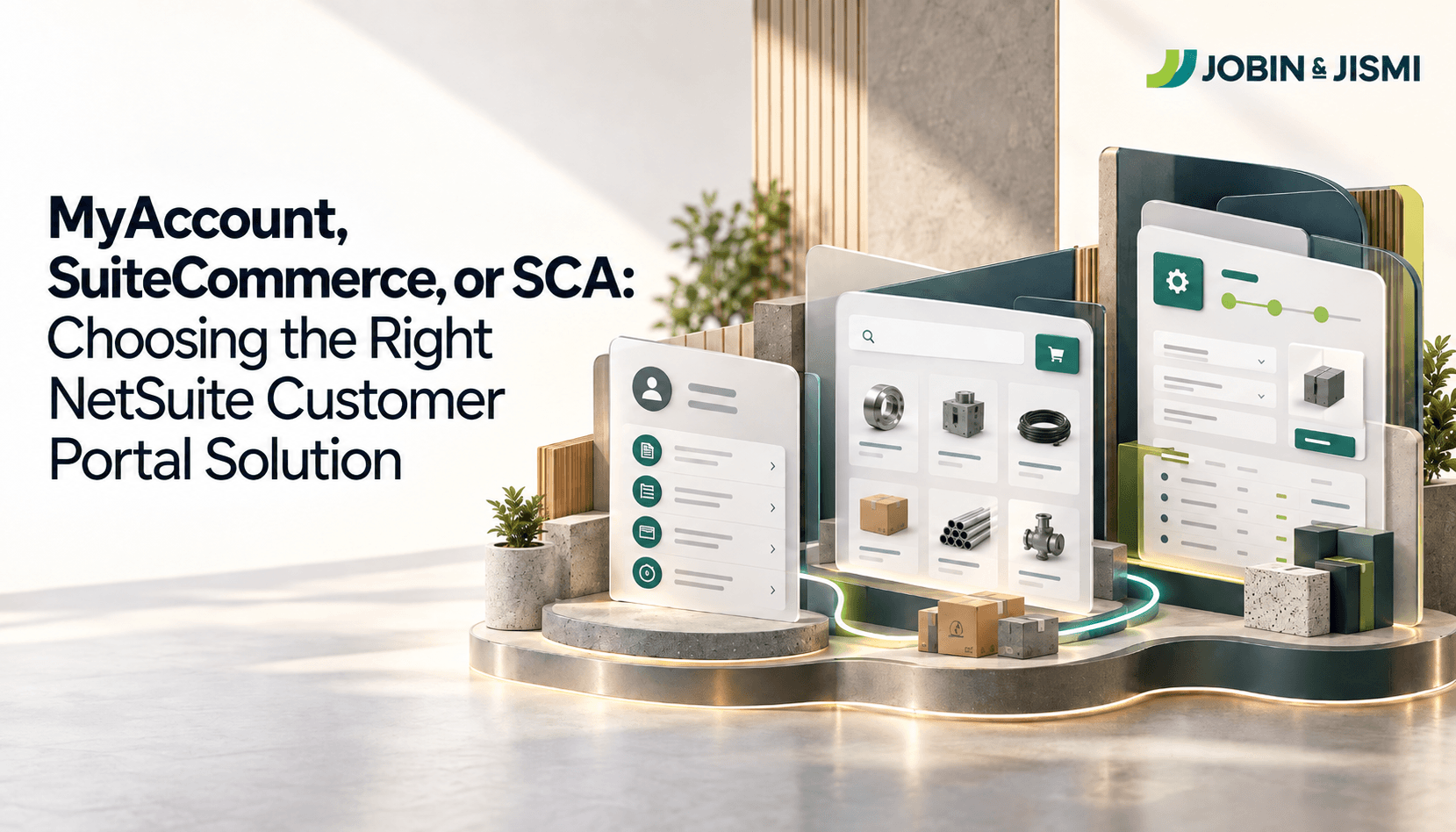
Your customers call to check an invoice, confirm an order status, or place the same order they placed last month. Your team knows these requests belong online. The harder question is which product to put them on.
Ask three people and you may hear three answers: MyAccount, SuiteCommerce, or SuiteCommerce Advanced. All three are Oracle NetSuite customer portal solutions built on the same Commerce framework, which is exactly why they are easy to confuse. This guide from the SuiteCommerce team at Jobin & Jismi, an Oracle NetSuite Solution Provider Partner in India, sorts them out by the job your customers need done. It covers who each option fits, what it does, where it stops, and the licensing detail that buyers often meet too late in the process.
Why should you start with the customer's job, not the product?
The most reliable way to choose a NetSuite customer portal is to list what your customers need to do without calling your team, then match that list to a product. Product-first conversations tend to drift toward the largest option. Job-first conversations usually land on the smallest option that works.
The stakes are rising. McKinsey's 2026 Global B2B Pulse Survey, drawing on nearly 4,000 decision-makers across 13 countries, found that 71% of B2B companies now offer eCommerce, and among those, roughly one-third of revenue flows through digital channels. Not every B2B buyer wants a storefront, though. Many simply want to find an invoice, check a balance or pay a bill without picking up the phone.
Which NetSuite customer portal solution fits your business needs?
The table below is organized by customer needs rather than by product. Find the row that describes what your customers do today, and the column on the right names the portal that covers it.
If your customers need to… | You need |
View invoices, pay bills, check balances and transaction history, print statements, reorder past purchases, and manage support cases and quotes | SuiteCommerce MyAccount |
Browse a catalog, see their contract pricing, place new orders and reorder | SuiteCommerce |
All of the above, plus business-specific buying workflows that need code-level customization | SuiteCommerce Advanced (SCA) |
What does each NetSuite customer portal offer?
MyAccount, SuiteCommerce and SCA form a progression. Each tier includes the account self-service of the one before it and adds capability, along with more to license, configure and maintain.
SuiteCommerce MyAccount: account self-service
Who it fits. SuiteCommerce MyAccount suits businesses whose customers already know what they buy and mostly need to manage the account around it. Trade customers who reorder regularly, and businesses whose new orders still come through sales reps, are common examples.
What it does. Oracle describes SuiteCommerce MyAccount (SCMA) as a self-service web portal where customers manage account information, view recent transactions and pay invoices. Customers can see purchase history, reorder previously purchased items, view and request returns, check account balances, view invoices and transaction history, make payments, print statements, and manage support cases and quotes. Sales reps create quotes on NetSuite, and customers can then manage them and convert them to sales orders.
How far it can be customized. MyAccount can carry your brand. Site Management Tools (SMT) work with SCMA, so you can create landing pages, change page layouts and adjust the look and feel through the SuiteCommerce Base Theme. Oracle also confirms that many SuiteCommerce extensions can be activated on an SCMA domain. NetSuite MyAccount customization therefore runs through configuration, extensions, the Extensibility API and SMT. Code-level changes, as made on SCA, are not available for SCMA.
SuiteCommerce: self-service plus online ordering
Who it fits. SuiteCommerce suits businesses that want customers to find products, see their own prices and place orders online, alongside the account functions MyAccount provides.
What it does. SuiteCommerce is NetSuite's primary eCommerce shopping solution, with a full shopping experience that includes My Account functionality and the ability to search, browse and add items to a cart or wishlist. Every SuiteCommerce site combines three applications: Shopping, Checkout and My Account. For B2B buyers, pricing often decides the matter. NetSuite lets you assign custom price levels to customers, and Oracle confirms that customers see that price in your web store after they log in. A SuiteCommerce implementation works from the same customer, item and pricing records your team already maintains in NetSuite.
When to look further. When a required buying journey sits outside what themes, extensions and the Extensibility API are designed to support, it is time to evaluate SCA.
SuiteCommerce Advanced (SCA): the same platform with source code control
Who it fits. SCA suits businesses with specialized purchasing workflows that the standard extension framework is not designed to address.
What it does. SCA delivers the shopping, checkout and My Account capabilities of SuiteCommerce. In Oracle's words, the crucial difference is that with SCA you are also able to modify the source code. Even then, Oracle's guidance is to override or extend existing source code rather than edit it directly when the Extensibility API does not expose what you need.
What it asks of you. That control comes with ownership. SuiteCommerce is updated automatically by NetSuite, while SCA sites move between versions through an upgrade process that must carry your customizations with them. This is why SuiteCommerce Advanced implementation services should begin with one question: does this requirement truly need code?
How does SuiteCommerce MyAccount licensing work?
Every SuiteCommerce license already includes a My Account portal. One SuiteCommerce license lets you run one SuiteCommerce website and includes a My Account portal and a secure domain. If you are buying SuiteCommerce, you do not need a separate MyAccount product for account self-service.
A standalone SuiteCommerce MyAccount site is a different matter. SCMA needs a separate license, and that one SCMA license gives you a My Account portal and a secure domain. This detail tends to surface late in buying conversations, which is why we raise it at the start of every portal scoping discussion. Confirm current licensing terms with your Oracle NetSuite account team or partner before you budget.
Can you have both MyAccount and SuiteCommerce or SCA?
Yes. A business can run a SuiteCommerce or SCA site and a separate SuiteCommerce MyAccount site at the same time, with the SCMA site on its own license. With both licenses, you get two My Account portals and two secure domains: one standalone, and one linked to your Commerce site.
This arrangement makes sense when distinct customer groups need separate experiences or domains. It should not be the default architecture. If the My Account area of your existing Commerce site already supports the self-service journey, a second portal adds licensing, administration and implementation work without solving a separate business problem.
Why should you configure before you customize?
Configure SuiteCommerce MyAccount rather than customize it, and the same principle serves every Commerce site. We apply it as a fixed order of operations:
- Configure. Use the Commerce configuration record, Customer Center custom permissions, transaction list columns and Site Management Tools.
- Extend. Activate Oracle-built or partner extensions, then build custom extensions through the Extensibility API where a gap remains.
- Customize source code. Move to SCA customization only for a specific, named requirement the first two steps cannot meet, and only when the business case justifies the ongoing upgrade work.
Each rung adds testing and maintenance. NetSuite B2B customer portal development that stays on the first two rungs is easier to test, maintain and update through future releases.
What should you evaluate before choosing a NetSuite customer portal?
Before choosing a SuiteCommerce customer portal or a standalone MyAccount site, assess the customer journey and your existing NetSuite environment:
- Whether customers mainly need account information, or full online purchasing
- Existing Commerce licenses, price levels, integrations and customizations
- Whether a NetSuite customer portal integration must preserve current processes, such as how quotes, returns and payments flow today
- How much customization your team, or your partner, is prepared to maintain through future upgrades
- Whether NetSuite implementation services are needed to assess the approach before you commit
- Whether anticipated requirements justify the ownership that deeper customization brings
Choosing the right NetSuite customer portal solution
Choosing between NetSuite customer portal solutions comes down to two questions: what your customers need to do online, and how much complexity your business is prepared to own. For many businesses, the answer is smaller than expected. A well-planned SuiteCommerce implementation also accounts for existing pricing, integrations, customizations and long-term maintenance from the start.
Jobin & Jismi is an Oracle NetSuite Solution Provider Partner in India, and our SuiteCommerce team helps businesses scope this decision, whether the answer is MyAccount, SuiteCommerce or SCA. Explore our SuiteCommerce development services, or read how customer-specific pricing works in NetSuite
Not sure which portal your customers need?
Book a portal scoping conversation with our SuiteCommerce team. We will map your customers' jobs to the smallest NetSuite customer portal that fits, before any product discussion.
on LinkedIn


Frequently Asked Questions
Start with the activities your customers need to complete online, then pick the smallest product that covers them. SuiteCommerce MyAccount covers account self-service such as invoices, payments, balances and support cases, SuiteCommerce adds catalog browsing and online ordering, and SuiteCommerce Advanced (SCA) adds source code control for workflows that themes and extensions cannot support.
SuiteCommerce MyAccount includes only the My Account application, while SuiteCommerce includes Shopping, Checkout and My Account. MyAccount customers can view transactions, pay invoices, reorder past purchases and manage quotes and support cases, but they do not browse a catalog, use a shopping cart or enter new orders. SuiteCommerce adds those shopping and checkout features.
Yes. A business can run a SuiteCommerce or SCA site and a separate SuiteCommerce MyAccount site at the same time. The separate MyAccount site needs its own SCMA license and comes with its own My Account portal and secure domain, so add it only when a distinct customer group needs a separate self-service experience.
It depends on how your B2B customers buy. If they mainly need invoices, statements and payments, SuiteCommerce MyAccount is usually enough. If they order online at negotiated prices, SuiteCommerce fits, because NetSuite can assign custom price levels that customers see after they log in. SuiteCommerce Advanced suits B2B buying workflows that need code-level customization.
Yes, at different depths. SuiteCommerce MyAccount can be customized through configuration, Site Management Tools, extensions and the Extensibility API, but not through code-level changes. SuiteCommerce supports themes and extensions, and SuiteCommerce Advanced adds the ability to modify source code.
Choose SuiteCommerce when customers need to browse products, see their pricing and place new orders online. Oracle's documentation confirms that SuiteCommerce MyAccount does not include a shopping cart, item browsing or new order entry, and that its checkout is limited to paying existing quotes or invoices and reordering past purchases.
Yes, a business can change its portal strategy as customer needs grow. SuiteCommerce MyAccount uses the same framework as SuiteCommerce and that My Account customizations should work the same across versions, which simplifies the move. Assess licensing, configuration, integrations and extensions before making the transition.
Consider customer needs first, then licensing, existing pricing setup, integrations, customization depth and long-term maintenance. SuiteCommerce sites update automatically while SCA customizations must be carried through version upgrades, so the customization decision has an ongoing cost. For complex requirements, SuiteCommerce Advanced implementation services can scope the approach before development starts.