

AI Proof of Concept: What Should Businesses Validate First?



An AI model can perform well in a demonstration and still fail to meet the data and operational requirements of a real business process. An AI Proof of Concept tests whether a proposed solution can address a specific problem and deliver measurable value before the business commits a full budget to it.
This guide is written for CEOs, CFOs and operations leaders who approve AI investment. It covers what to validate first, how to measure success, the mistakes that waste PoC budgets, and when to move to full implementation.
What Is an AI Proof of Concept?
An AI Proof of Concept is a development and testing exercise that determines whether a proposed AI solution is technically feasible and suitable for a business. It validates critical assumptions before the business commits to broader development and deployment. Rather than building a complete application, the AI PoC tests selected capabilities using relevant data, predefined objectives and measurable evaluation criteria.
An AI PoC is not a production-ready application. Its findings show whether the proposed approach deserves further investment, needs a change in scope, or should stop.
Why Do Businesses Need an AI Proof of Concept Before Full Implementation?
Gartner reported in January 2026 that by the end of 2025, at least 50% of generative AI projects had been abandoned after the proof-of-concept stage. Gartner named poor data quality, inadequate risk controls, escalating costs and unclear business value as the causes. An AI Proof of Concept for Businesses exposes these uncertainties while the project is still small in scope and cost. A well-run PoC helps a business do five things.
Identify unsuitable use cases: Not every business problem needs AI. An AI feasibility assessment shows whether AI is the right tool, or whether conventional automation can meet the requirement at lower cost.
Identify data-related limitations: Assess data availability, quality and accessibility to find gaps that would weaken AI model evaluation and the reliability of the PoC results.
Evaluate technical feasibility: Test the essential integrations with existing business applications to expose technical constraints and potential AI implementation risks before full development.
Understand implementation costs: Assess the total investment, including model development, infrastructure, API usage, integration, maintenance and employee support, not development expenses alone.
Assess operational suitability: Evaluate how employees will use AI-generated outputs, manage exceptions and provide human oversight, to confirm that the AI-powered business solutions fit existing workflows.
What Should Businesses Validate First in an AI Proof of Concept?
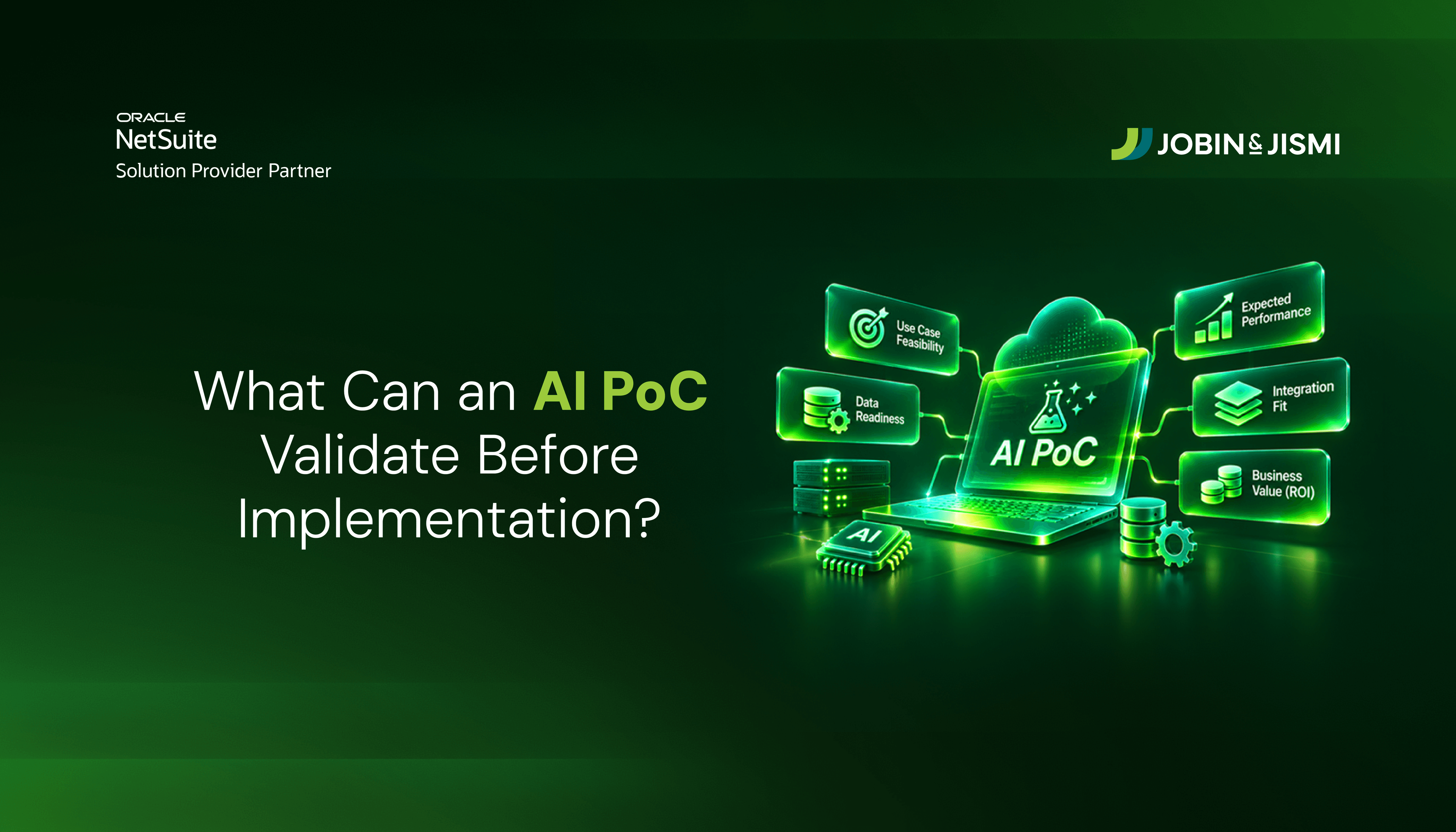
Seven areas decide whether an AI PoC produces enough evidence for the next investment decision. The order matters. If the business problem is unclear or the data is unusable, there is no point testing integration or scale yet.
Business Problem and AI Use-Case Suitability
AI project validation begins with a clearly defined business problem. Start with a specific process, its current performance, and the improvement the proposed AI solution must demonstrate. Examples include reducing manual data entry, improving demand forecasts, detecting unusual transactions, or helping employees find business information faster. An AI feasibility assessment at this stage should also confirm that AI is necessary. If rules-based automation can solve the problem, the PoC should stop here.
Data Availability and Readiness
Data readiness depends on whether the required records are complete, current, accessible to the intended application, and representative of actual business transactions. The AI PoC should test representative data to show whether existing data gaps affect model performance, and what must be fixed before implementation.
AI Model Evaluation and Output Reliability
AI Model Evaluation should establish whether the selected model produces accurate, consistent and relevant results under the conditions in which it will be used. The right metrics depend on the task. Classification models are measured using precision, recall and F1 score. Forecasting models require measures of prediction error. Generative AI applications should be assessed for factual accuracy, relevance, groundedness and compliance with task instructions. Test with inputs taken from real transactions, including incomplete and unusual ones, not only clean samples. [INTERNAL LINK: How to Evaluate a Custom AI Model Before Using It in Business Operations]
Technical Feasibility and System Integration
An isolated model test does not establish whether the solution can exchange data with other business applications while respecting existing access permissions and system dependencies. The AI PoC should assess system compatibility, API availability, data connections, infrastructure and third-party dependencies. Testing at least one critical integration path end to end, such as retrieving CRM data under a real user's permissions, exposes technical constraints, integration costs and AI implementation risks early. It also tells the AI development services team how much work remains before deployment.
ERP vendors are now building these controls into the platform. Oracle NetSuite's AI Connector Service connects external AI clients to NetSuite through the Model Context Protocol (MCP). The connector cannot be used with the Administrator role, and each role must be explicitly granted the MCP Server Connection permission, so the AI client can reach only the data that role is allowed to see. A PoC that touches NetSuite should be tested under these role permissions from the first day.
Security, Data Privacy, and AI Governance
Businesses should assess how the AI solution accesses, processes and protects confidential information. The PoC should evaluate data privacy, user access controls, security safeguards, compliance requirements and accountability for AI-generated outputs. Gartner lists responsible AI treated as an afterthought among five critical failure points for generative AI projects. Set up role-based access, human verification of high-impact outputs and audit procedures during the PoC, not after it, so these AI implementation risks surface before deployment.
INDIA INSIGHT
The Ministry of Electronics and Information Technology (MeitY) notified the Digital Personal Data Protection (DPDP) Rules, 2025 in November 2025. The core obligations for Data Fiduciaries, including consent notices, reasonable security safeguards and personal data breach reporting, apply from 13 May 2027. An AI PoC that processes customer or employee personal data in India today should be designed to meet those obligations, because a production rollout approved now is likely to go live close to that date.
Workflow Compatibility and Operational Readiness
Technical performance alone does not guarantee that an AI solution will fit existing business workflows. The AI Proof of Concept should assess how employees use AI-generated outputs, review results and handle exceptions without adding unnecessary manual work. It should also assign clear owners for oversight, performance monitoring, error correction and ongoing maintenance after deployment.
Scalability and Financial Viability
Before approving wider implementation, assess whether the solution can handle expected transaction volumes, users and workloads without unacceptable performance or cost increases. Review infrastructure capacity, response times, system availability, model and API usage charges, integration expenses, maintenance and employee support. This shows whether the proposed AI-powered business solutions can deliver enough value to justify further investment in custom AI solutions for businesses.
How Can Businesses Measure the Success of an AI Proof of Concept?
Measure an AI PoC against success criteria agreed before testing starts, not after the results arrive. The lack of clear success metrics and measurable business value are a primary reason generative AI projects are cut when budgets tighten. Each measure below needs a baseline from the current process and a pass threshold agreed by the business owner.
Measure | What it tells you | Example indicators |
Business outcome | Whether the target process actually improves | Manual hours per week, forecast error, invoice processing time |
Model performance | Whether outputs are reliable enough to act on | Precision and recall, prediction error, groundedness of answers |
Operational fit | Whether employees can use it without extra work | Share of outputs accepted without correction, exception volume |
Cost and scale | Whether the economics hold at real volume | Cost per transaction, response time at expected load |
Close the PoC with a documented decision to proceed, revise the scope or stop, based on these thresholds. A clear stop decision is a successful outcome, because it prevents a larger investment in an approach that would not have worked.
AI Proof of Concept vs. Prototype vs. MVP
A PoC, a prototype and a minimum viable product (MVP) answer different questions, so one should not be used in place of another.
Comparison | AI Proof of Concept (PoC) | Prototype | Minimum Viable Product (MVP) |
Primary purpose | Validates whether the proposed AI solution is technically feasible and addresses the intended business requirement. | Demonstrates how the solution may look, function and interact with users. | Delivers a usable version with essential features for real-world use. |
Main focus | Technical feasibility and business assumptions. | User experience, design and functionality. | Usability, performance and user feedback. |
Typical audience | Technical teams and business decision-makers. | Stakeholders and selected end users. | Target users and customers. |
Development scope | Limited testing of selected AI capabilities. | A working representation of the proposed solution. | A functional product with essential features. |
When to use | Before committing to full AI development, when feasibility or business value needs validation. | When stakeholders need to review the proposed design and user experience. | When the solution is ready for practical use and feedback from real users. |
Common Mistakes Businesses Should Avoid During AI PoC Development
Starting without a defined business objective: Selecting an AI model before identifying the business problem produces a PoC that demonstrates technical capability without delivering business value or supporting clear AI project validation.
Testing with limited or unrealistic data: A small or hand-picked dataset can produce misleading results, and gaps in data quality and availability weaken the reliability of the AI feasibility assessment.
Evaluating only model accuracy: A model can generate accurate outputs and still need extensive employee corrections, fail to fit existing workflows, or deliver limited business value.
Postponing integration and security assessments: Ignoring ERP, CRM and other system dependencies, along with privacy and access-control requirements, pushes technical constraints and AI implementation risks to the end of the project, when they are most expensive to fix.
Expanding the PoC scope unnecessarily: Validating several unrelated use cases at once increases development effort and makes the results difficult to assess.
Treating PoC success as production readiness: A solution that performs well in a controlled test can still struggle with real users, higher transaction volumes, continuous workloads or operating costs.
When Should Businesses Move from AI Proof of Concept to Full Implementation?
Businesses should move from an AI Proof of Concept to full implementation when the solution demonstrates measurable business value and meets essential technical and operational requirements. In practice, that means all of the following are true:
- The AI PoC has met the success thresholds agreed before testing began.
- AI model evaluation confirms that outputs stay accurate and consistent under realistic business conditions.
- The required data is reliable, and critical integration with other applications is feasible.
- Security, privacy and governance requirements are addressed, including role-based access and human review.
- The cost at expected volume still supports the business case.
Once these conditions are met, proceed with a pilot or phased deployment before expanding the solution across operations. If significant gaps remain, further AI project validation is needed before committing to full implementation.
From AI Proof of Concept to Successful Implementation
An AI Proof of Concept helps businesses move from assumptions to evidence before committing to full-scale implementation. By validating the business problem, data readiness, model performance, system integration, security, workflow compatibility and financial viability, businesses can identify AI implementation risks early and make informed investment decisions.
Jobin & Jismi helps businesses assess AI feasibility, integrate AI with existing business applications, and develop custom AI solutions for businesses. With the right AI development services and a clearly defined implementation approach, businesses can turn validated use cases into AI-powered business solutions that address real operational needs.
Planning to implement AI in your business? Connect with Jobin & Jismi to assess your AI readiness, validate your use case, and identify the right approach for AI implementation.
on LinkedIn

Frequently Asked Questions
An AI Proof of Concept typically takes a few weeks to a few months, depending on the use case, data availability, integration requirements and testing scope. A narrowly defined objective and accessible data shorten the timeline, while each additional system integration lengthens it.
Yes. Businesses can use existing data from ERP, CRM, finance, inventory and other applications to develop an AI PoC. The data should first be checked for quality, relevance, accessibility and security.
An unsuccessful AI PoC identifies limitations such as inadequate data, poor model performance, integration challenges or insufficient business value before a larger investment is made. Businesses can use these findings to revise the approach, explore alternatives, or stop the initiative.
Yes. An AI PoC can test how an AI solution interacts with existing ERP and CRM systems through APIs, data connections or vendor-provided connectors. For example, Oracle NetSuite's AI Connector Service links external AI clients to NetSuite through the Model Context Protocol (MCP) and limits each AI session to the permissions of a non-administrator NetSuite role. Testing these connections during the PoC confirms compatibility, data access and integration effort before full implementation.
An AI Proof of Concept investigates whether an AI-based approach is suitable and feasible for a specific business requirement. Traditional software testing checks whether a built system meets defined functional and non-functional requirements, such as reliability, security, performance and integration. AI solutions also need ongoing evaluation after the PoC, because model outputs can vary across inputs and operating conditions.