

NetSuite EPM: Features, Benefits and 2026 Updates



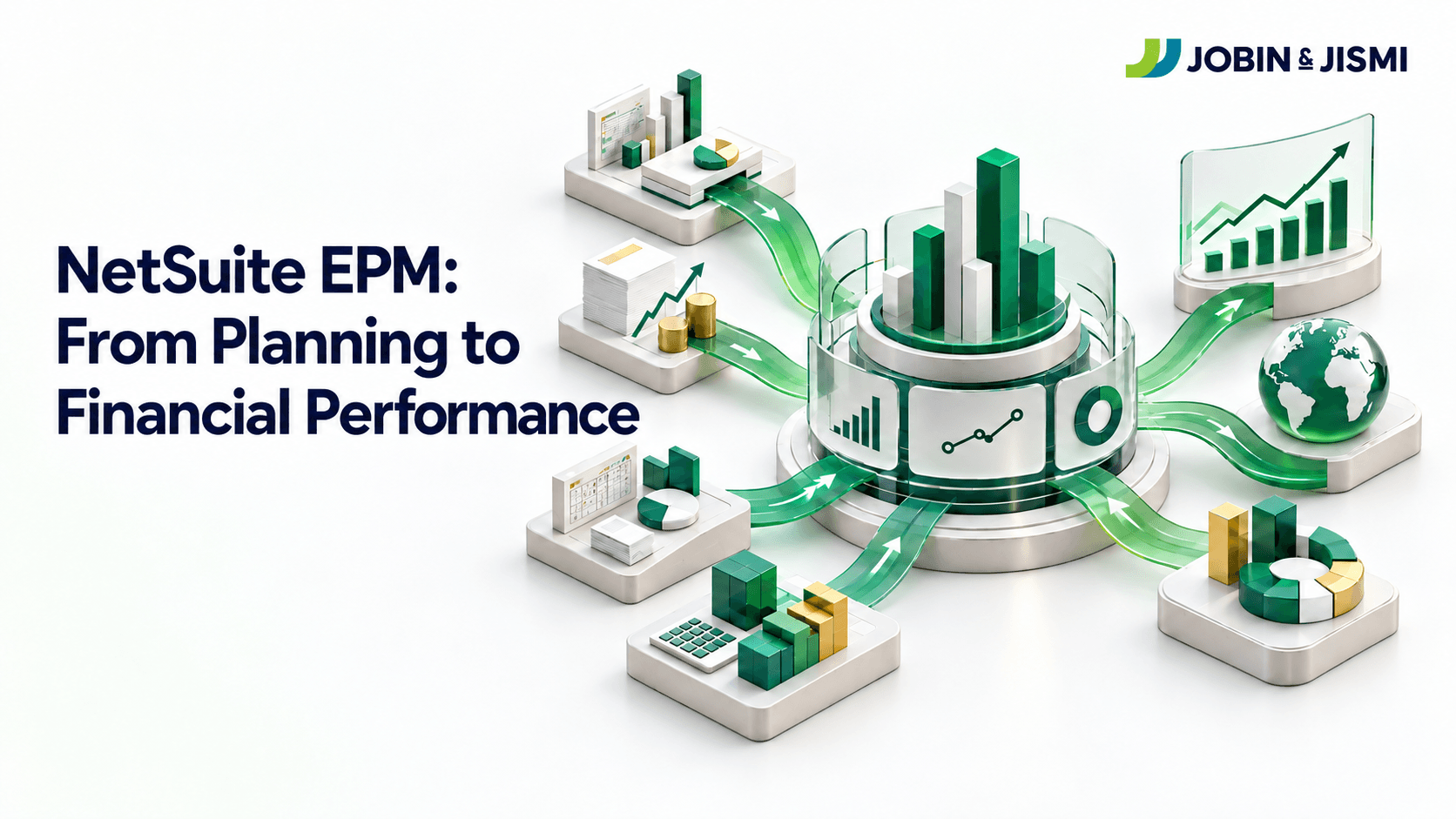
NetSuite Enterprise Performance Management (EPM) is Oracle's cloud platform for financial planning, budgeting, forecasting, account reconciliation, financial close, consolidation, profitability analysis, and corporate tax reporting, built on Oracle's Fusion Cloud EPM technology and connected to NetSuite's financial data. Finance teams typically adopt it once spreadsheet-based planning across multiple entities, contributors, and forecast versions becomes difficult to reconcile and govern reliably.
Why Finance Teams Reach for NetSuite EPM
Planning complexity tends to surface gradually. A finance team adds an entity, a new forecast version, or another set of intercompany eliminations, and the spreadsheet chain that worked at a smaller scale starts breaking in places nobody notices until close.
According to the Association for Financial Professionals' (AFP) 2025 FP&A Benchmarking Survey of 362 finance and FP&A practitioners, 96 percent still use spreadsheets for planning, and 93 percent use them for daily or weekly reporting, even at organizations that have already invested in dedicated planning tools. The same survey found that data reliability and accessibility remain persistent technology challenges for FP&A teams.
NetSuite EPM connects planning, budgeting, forecasting, account reconciliation, financial close, consolidation, profitability analysis, and corporate tax reporting to NetSuite's underlying financial data. For a business already running NetSuite as its ERP, the practical shift is less manual consolidation between systems and files, and a planning process that can be governed and audited rather than rebuilt every reporting cycle.
What Are the Key Features of NetSuite EPM?
Each of these capabilities exists to answer one practical question for a CFO. “where does this number come from, and can it be defended under scrutiny”.
Planning and Budgeting
A budgeting cycle that depends on emailed spreadsheet versions is hard to defend when a number is questioned in a board meeting. NetSuite EPM's Planning and Budgeting module supports driver-based budgeting, forecasting, financial modelling and what-if analysis, so assumptions can be tied to operational drivers such as headcount, unit volume or utilisation rather than a manually maintained cell reference. Planning built this way is easier to explain, and easier to update when a single assumption changes.
Account Reconciliation
Connecting NetSuite's financial data directly with the Account Reconciliation module keeps reconciliation inside a controlled workflow rather than a set of spreadsheets passed between the general ledger team and the controller. Teams can manage account reconciliations, investigate variances, and retain supporting documentation as part of the same governed process used for close, which matters most during an audit, when that documentation has to be produced quickly.
Financial Close and Consolidation
For a business running several legal entities, currencies, or intercompany relationships, period-end close is usually where planning gaps become visible fastest. NetSuite EPM supports period-end close and financial consolidation across entities, currencies, and intercompany relationships within one connected environment, which reduces the number of manual eliminations a controller has to track by hand.
Profitability and Cost Managementl
Cost and profitability data is one of the areas most finance functions still model manually. As reporting requirements grow more granular, that reliance on manually maintained models becomes harder to sustain. NetSuite EPM's Profitability and Cost Management capabilities show how costs and revenues contribute to profitability across products, customers, regions, services or other organisational dimensions the business already tracks.
Corporate Tax Reporting
NetSuite EPM also connects tax-related processes to financial information from the NetSuite general ledger, supporting corporate tax reporting, tax provisioning and processes such as transfer pricing and country-by-country reporting.
What Are the Key NetSuite EPM Integration Updates in 2026?
NetSuite's 2026.1 release, effective January 2026, updated the integration layer connecting NetSuite to Oracle Cloud EPM applications: the NetSuite EPM Connector, Planning and Budgeting Sync, Account Reconciliation Sync, and Close Management and Consolidation Sync. The changes focus on integration control, configuration management, and how financial data moves between the two environments.
More Control Over EPM Connector Configuration
As of the 26.1 release, the NetSuite EPM Connector can export its full configuration to a single file, which can be used as a backup or imported directly into another NetSuite account. For a business managing more than one NetSuite environment, or a partner supporting an implementation or migration, that removes a meaningful amount of manual reconfiguration work.
Enhanced Planning and Budgeting Integration
Planning and Budgeting Sync 26.1 adds a setting to verify that the correct Cloud EPM application is connecting to NetSuite, and automates the allowlisting of default saved searches and datasets, so administrators no longer add the required prefixes by hand. The same release folds NetSuite SuitePeople saved searches into Planning and Budgeting Sync directly, so payroll data and related metadata can be loaded into the platform and viewed by workforce category, connecting payroll information to workforce planning without a separate integration.
More Flexible Account Reconciliation Data Integration
Account Reconciliation Sync 26.1 adds the same connection-verification control, introduces SuiteQL-based queries for loading transaction data and metadata, and lets users schedule and run Pipeline and Import Profile jobs directly from within NetSuite rather than from the Cloud EPM side.
Expanded Financial Consolidation and Close Integration
Close Management and Consolidation Sync 26.1 extends the same connection-verification and automated allowlisting controls, adds SuiteQL support for loading data into Financial Consolidation and Close, and expands relative-period options for data-load and group jobs to include a period before the previous period.
What Are the Benefits of NetSuite EPM?
- Better executive decision-making: a consolidated view of financial and operational performance gives leaders a common set of numbers to work from, rather than reconciling different versions before a decision can be made.
- More accurate financial planning: connecting actuals, budgets, forecasts, and business drivers lets finance leaders test assumptions and set targets tied to how the business actually operates, not just to last year's numbers.
- Faster financial close: automating close and reconciliation tasks that were previously manual tends to shorten how long finance takes to produce reliable results, giving executives earlier visibility into performance.
- Enterprise-wide performance visibility: bringing performance information together across entities, departments, and business lines makes it easier to see where to focus attention, instead of reviewing each unit's numbers separately.
- Stronger strategic alignment: Gartner reports that only 3 percent of companies have strategic, operational and financial planning processes that are fully aligned and integrated. EPM gives finance and operational teams a shared planning process, so budgets, forecasts, and performance targets are more likely to reflect the same priorities.
- Greater financial and operational control: standardised processes and shared visibility make it easier to catch variances and emerging issues early, which is where financial oversight and risk management actually happen.
NetSuite EPM vs. Traditional Financial Planning: What's the Difference?
| Traditional Financial Planning | NetSuite EPM |
|---|---|
| Planning data may be maintained across multiple spreadsheets and files. | Planning and performance processes are managed through a connected EPM environment. |
| Actuals and planning data may require manual consolidation. | Financial and operational information is connected directly to planning and performance processes. |
| Forecasts can depend heavily on manually updated assumptions. | Driver-based planning, forecasting, modelling and what-if analysis support structured scenario evaluation. |
| Changes to assumptions can require updates across multiple files or models. | Centralised planning models provide a more controlled environment for evaluating changes. |
| Reconciliation and close activities may operate separately from planning. | Planning, reconciliation, close, consolidation, profitability and tax processes are brought together within one framework. |
| Spreadsheet-based processes can make version control and governance more difficult as complexity increases. | Defined workflows, roles and integration controls provide a more structured approach to managing EPM processes. |
How Should a Business Approach a NetSuite EPM Implementation?
In our EPM engagements, sequencing the work in phases keeps scope manageable and gives the business usable results at each stage, rather than a single large deliverable at the end.
- Establish the planning and data foundation
Start by defining the planning structure, financial dimensions, reporting requirements and data sources. This includes determining how NetSuite data will connect to EPM through the appropriate connector and integration processes, and establishing clear ownership for key planning data. - Expand into forecasting and performance management
Once the core planning structure is in place, introduce driver-based forecasting, scenario analysis and additional planning requirements, aligning financial assumptions with the operational drivers that actually influence business performance. - Extend to close, consolidation, and related processes
From there, extend EPM to processes such as account reconciliation, financial consolidation, profitability management or tax reporting, based on business priorities. This keeps implementation scope aligned with what the business actually needs at each stage, rather than expanding scope for its own sake.
Conclusion
The value of NetSuite EPM lies in bringing more structure to how a business plans, closes, and evaluates financial performance. It gives finance a stronger foundation for managing complexity across entities, aligning financial plans with business priorities, and assessing scenarios before they play out in the real numbers. The more useful question for most businesses is not whether EPM exists, but whether the current planning and performance process can support the scale, control, and decision-making the business already needs.
If you are assessing whether NetSuite Enterprise Performance Management fits your financial planning and performance management needs, Jobin & Jismi, an Oracle NetSuite Solution Provider Partner with a dedicated India practice, can help evaluate your finance processes, data requirements, and EPM strategy. Talk to our NetSuite consultants.
on LinkedIn

Frequently Asked Questions
NetSuite Enterprise Performance Management (EPM) is a cloud-based financial management solution that connects financial planning, budgeting, forecasting, account reconciliation, financial close, consolidation, profitability and cost management, and corporate tax reporting into one environment built on Oracle's Fusion Cloud EPM technology.
NetSuite EPM extends the financial data already in NetSuite ERP into planning, budgeting, account reconciliation, financial consolidation and related processes. Oracle provides the NetSuite EPM Connector and dedicated Sync SuiteApps (Planning and Budgeting Sync, Account Reconciliation Sync, and Close Management and Consolidation Sync) to move financial and related data between the two environments.
A business should consider EPM when financial planning, forecasting, reconciliation, consolidation or reporting has become difficult to manage through disconnected spreadsheets and processes. According to the AFP's 2025 FP&A Benchmarking Survey, 96 percent of finance practitioners still use spreadsheets for planning, which is exactly the pattern EPM is built to replace once it starts limiting reporting speed or governance.
No. NetSuite ERP is used to manage and record day-to-day business transactions, while NetSuite EPM focuses on planning, performance management, reconciliation, consolidation and related financial processes. The two work together: ERP provides the core financial and operational data, and EPM uses that data to support forward-looking planning and broader performance management.
Yes. NetSuite EPM supports financial processes involving multiple entities and currencies, including financial consolidation and intercompany activity. For organisations evaluating EPM, the more useful question is whether the solution fits their specific entity structure, reporting requirements, currencies, ownership arrangements and consolidation process, rather than simply counting the number of entities involved.
NetSuite EPM's Corporate Tax Reporting capabilities connect tax processes to the NetSuite general ledger, supporting transfer pricing and country-by-country reporting workflows. In India, groups above the prescribed consolidated revenue threshold must maintain Master File documentation under Rule 10DA and file country-by-country reports under Rule 10DB of the Income-tax Rules, 1962, and EPM's tax reporting layer is designed to support reconciling that documentation against consolidated financial data.